¿Qué estás buscando?


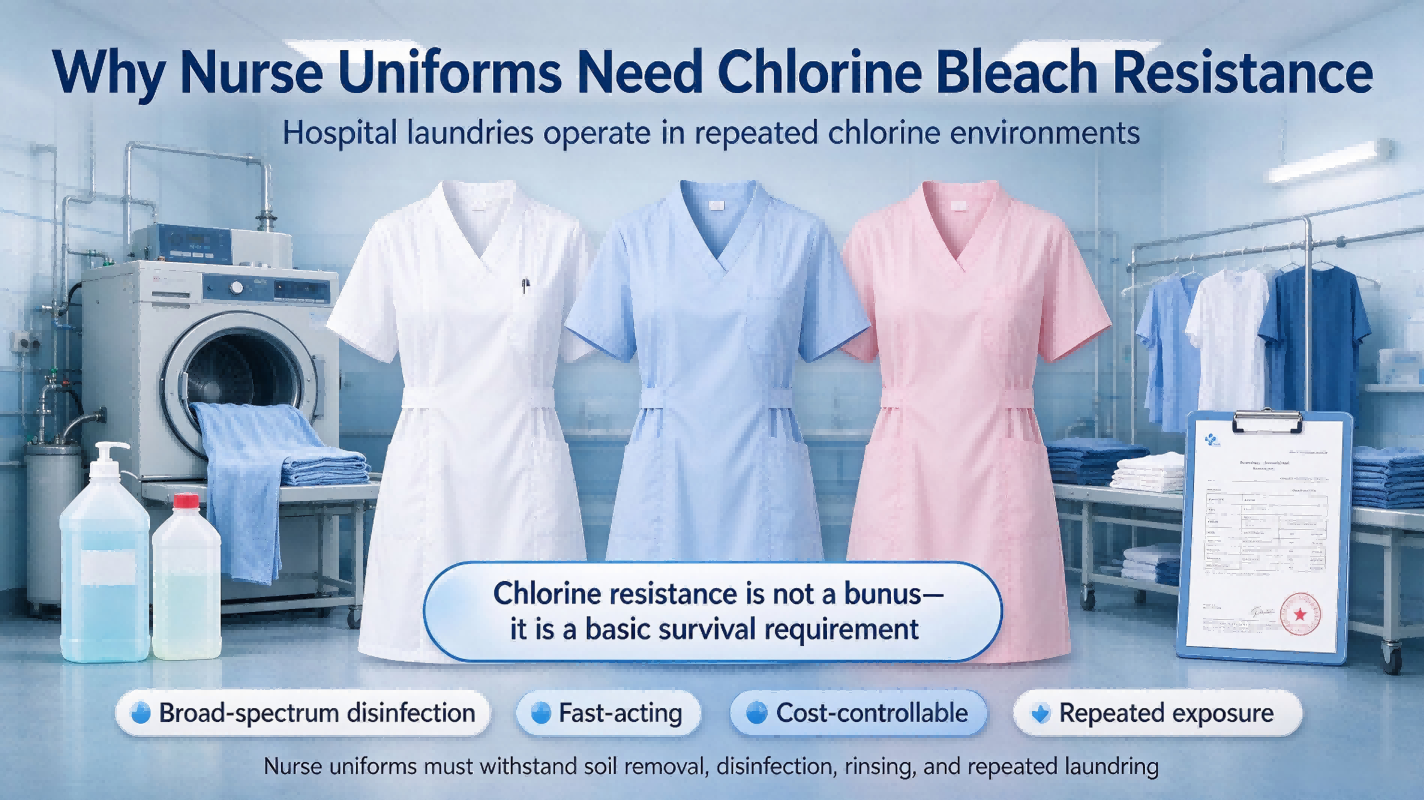
When buying nurse uniforms, there is an indicator that frequently appears in tender documents but that many people don't truly understand – chlorine bleach resistance.
"Chlorine bleach resistance grade 3-4," "chlorine bleach resistance ≥ grade 4" – what exactly do these numbers mean? Why do nurse uniforms specifically emphasise this requirement? What do chlorine-based disinfectants do to nurse uniform fabrics that makes "chlorine bleach resistance" a core threshold distinguishing nurse uniforms from ordinary workwear?
Today we're going to explain this clearly – from why hospitals cannot do without chlorine-based disinfectants, to the mechanism by which chlorine damages fibres, and then to how both procurement and washing/care should respond.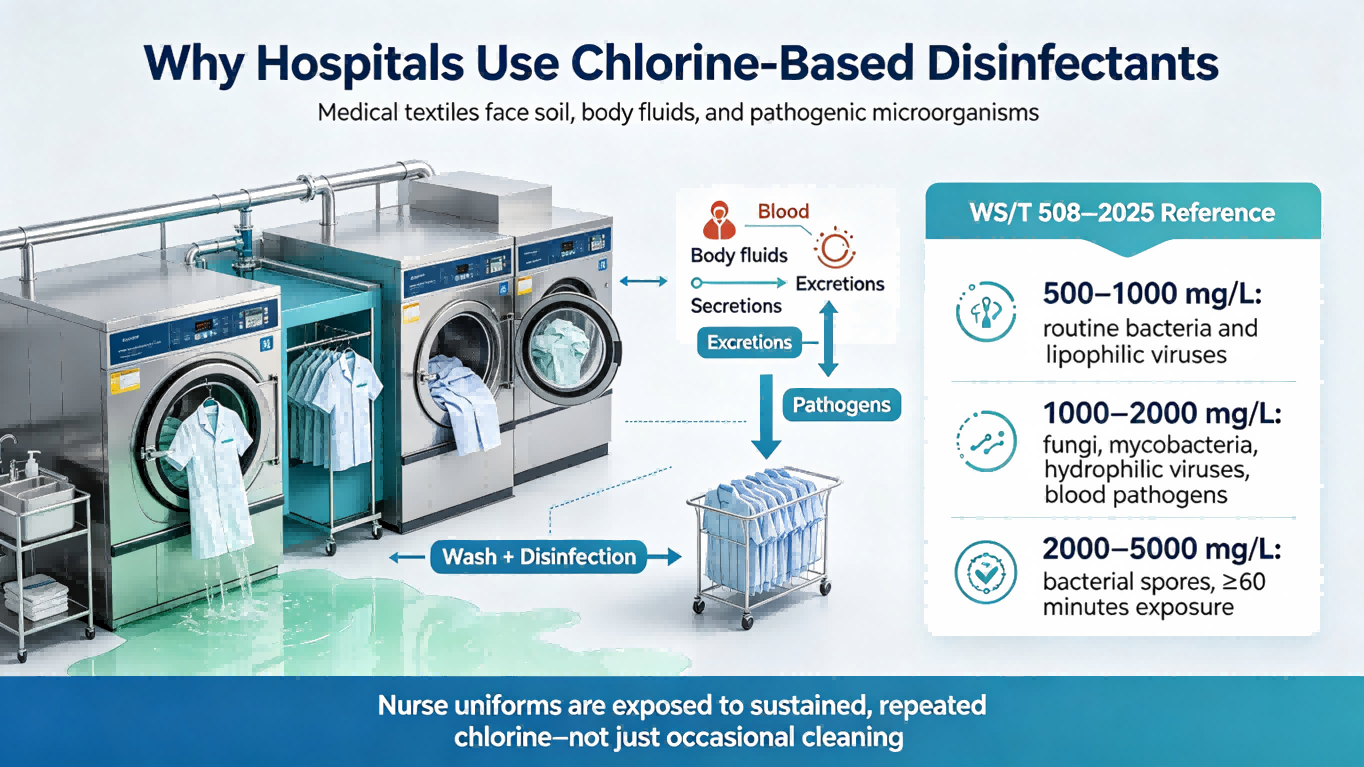
1. First, understand: why must hospitals use chlorine-based disinfectants?
Washing nurse uniforms isn't just about "getting them clean" – it must accomplish both soil removal and disinfection.
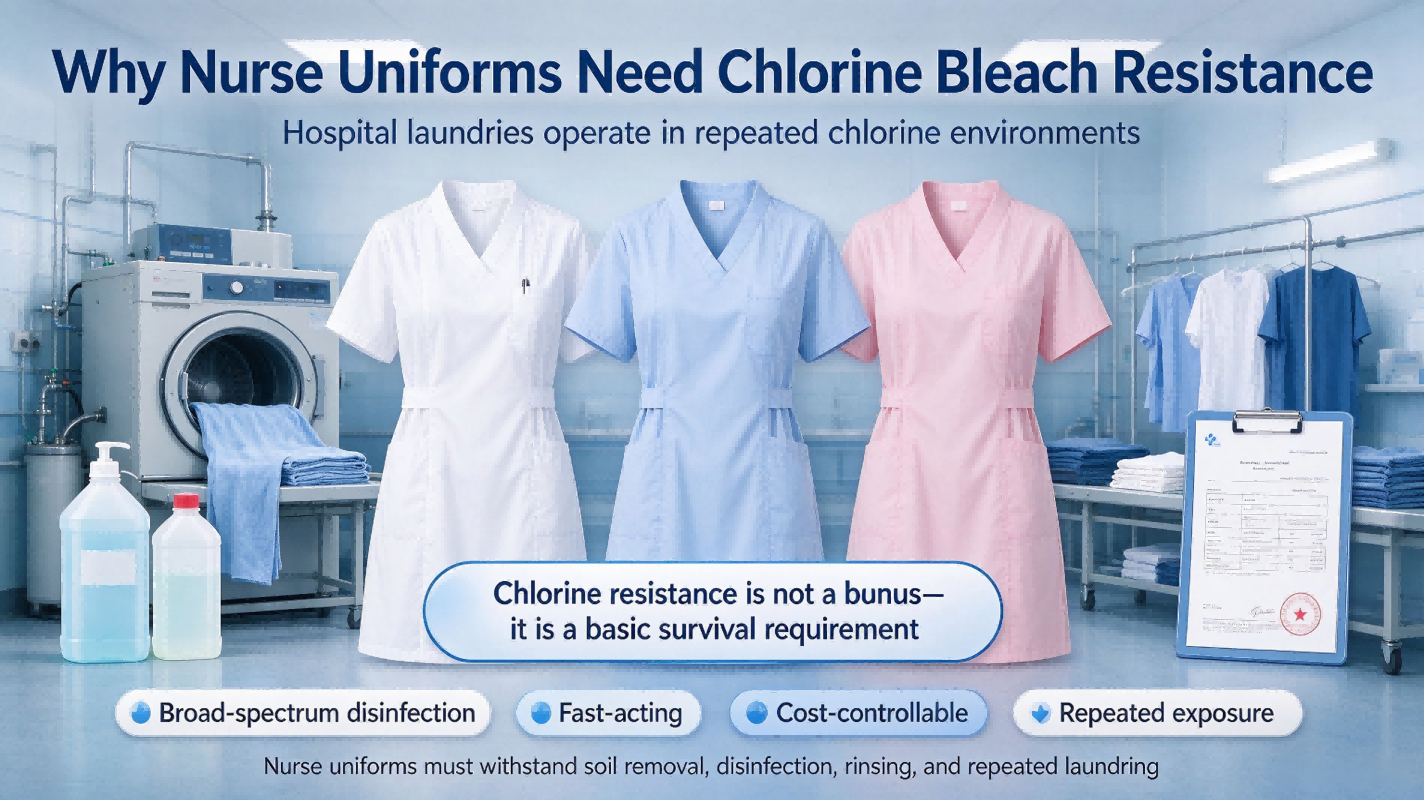
The contamination hospital laundries face is far more complex than ordinary clothing – blood, body fluids, secretions, excretions, and various pathogenic microorganisms. According to WS/T 508—2025 "Technical Standard for Washing and Disinfection of Medical Textiles in Medical Institutions", the washing and disinfection of medical textiles must use appropriate disinfection methods according to the type of contaminating pathogen. Chlorine-based disinfectants (represented by sodium hypochlorite) have become the mainstay of hospital laundries because they have a broad bactericidal spectrum, fast action, and controllable cost.
The specific concentration used depends on the type of contamination. According to WS/T 508—2025, textiles contaminated by lipophilic viruses and bacterial vegetative forms may use 500 mg/L–1000 mg/L chlorine disinfectant, with washing and disinfection for no less than 30 minutes; those contaminated by fungi, mycobacteria, hydrophilic viruses, or blood-borne pathogens require 1000 mg/L–2000 mg/L; those contaminated by bacterial spores require 2000 mg/L–5000 mg/L, with an exposure time of no less than 60 minutes.
In other words, in daily washing, nurse uniforms are not exposed to "a little chlorine" – they are exposed to a sustained, repeated, and not-insignificant chlorine environment. Chlorine bleach resistance is not an optional bonus – it is a basic condition for whether a nurse uniform can survive in a real washing system.
2. What do chlorine-based disinfectants do to fabric? More than just "fading"
Many people assume the effect of "chlorine bleaching" is simply colour fading. In reality, chlorine damages nurse uniforms starting from inside the fibre – colour change is only the most superficial manifestation.
First layer of damage: fibres are oxidised, and strength drops.
Sodium hypochlorite is a strong oxidising agent. While killing bacteria, it also oxidises cellulose molecular chains. Once cotton fibres are oxidised, their degree of polymerisation decreases, fibre strength drops, and the fabric becomes brittle and easily torn. Research has long pointed out that bleaching cotton fabric with sodium hypochlorite can cause chemical damage to the fibres and reduce strength. Chlorine treatment has two clear effects on cotton fabric: it reduces shrinkage, but at the same time reduces tensile strength.
Second layer of damage: latent damage – invisible during washing, exposed during wear.
This is the most hidden and troublesome aspect of chlorine bleaching.
After cotton fibres are oxidised by sodium hypochlorite, part of the damage does not immediately manifest as obvious fragility after washing and drying. But this doesn't mean the fibres are intact – they are in a state of "latent damage." When these already-damaged fibres later encounter alkaline conditions (such as alkaline components in detergent), the oxidised molecular chains break further, and strength drops sharply.
In other words, a nurse uniform may pass strength testing at the factory and look fine after a few washes, but the inside of the fibres has already been "hollowed out." After a few more washes, or when subjected to pulling during wear, breakage suddenly appears.
Third layer of damage: yellowing – the oxidation products themselves are coloured.
The reaction of chlorine with cotton fibres produces oxycellulose, and these substances themselves have a yellow tone. If the chlorine disinfectant concentration is on the high side, the exposure time is long, or rinsing is incomplete and residual chlorine continues to react, the fabric gradually yellows – and this yellowing is irreversible. The fibres have been altered; no amount of washing will whiten them again.
Fourth layer of damage: dyes in coloured nurse uniforms are destroyed.
Chlorine-based disinfectants attack not only fibres but also dyes. In coloured nurse uniforms (light blue, light pink, light green), dye molecules are oxidised and decomposed in a chlorine environment, manifesting as fading, blotchiness, and colour shade change. The problem with white nurse uniforms centres on yellowing and brittle damage; the problem with coloured nurse uniforms centres on fading and colour difference.
3. Colour fastness to chlorinated water: what the numbers mean
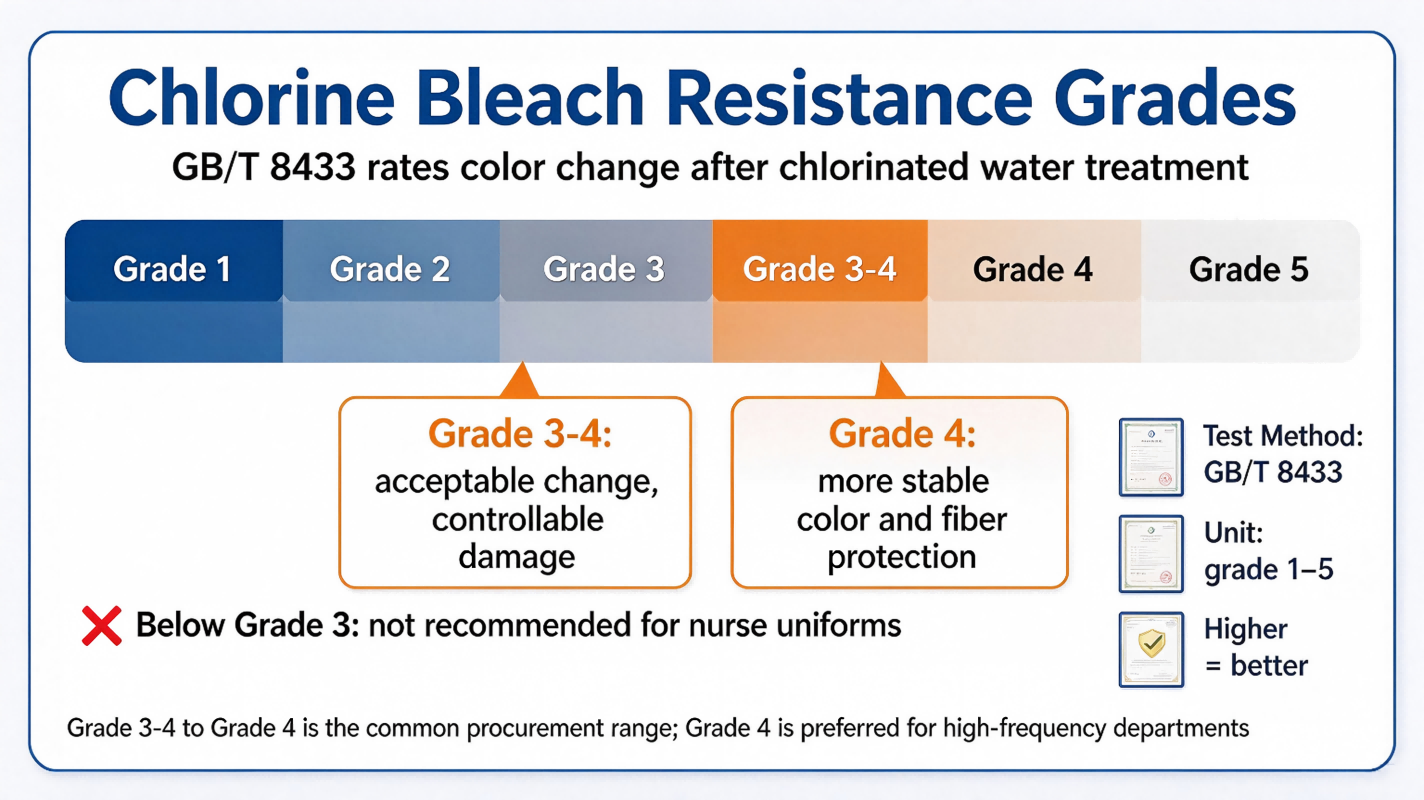
The commonly seen "chlorine bleach resistance grade 3-4" or "chlorine bleach resistance ≥ grade 4" in nurse uniform procurement is based on the rating system of GB/T 8433 "Textiles – Tests for colour fastness – Colour fastness to chlorinated water." This standard uses grades 1 to 5 to assess the fabric's ability to retain colour after treatment with chlorinated water – grade 5 is best (almost no change), grade 1 is worst (severe fading or staining).
In actual hospital procurement, the chlorine bleach resistance requirement for nurse uniforms usually falls in the range of grade 3-4 to grade 4. Many hospital procurement announcements explicitly include "chlorine bleach resistance grade 3-4" or "chlorine bleach resistance ≥ grade 4" as technical parameters and require third-party test reports as supporting evidence.
What does this grade mean?
Grade 3-4 is "can withstand it, but will change" – after the specified chlorinated water treatment, there is visible colour change, but it remains within an acceptable range, and fibre damage is controllable. For departments with moderate washing frequency and conventional chlorine concentrations, this grade can serve as a basic requirement.
Grade 4 is "withstands it relatively stably" – colour change is smaller, fibre damage is lighter, suitable for departments with high washing frequency and frequent chlorine disinfection use (ICU, emergency, infectious diseases).
Fabric below grade 3 is not suitable for nurse uniforms. Not because "the colour doesn't look good," but because it means the fabric will deteriorate rapidly in a chlorine environment – fading is only a signal; fibre brittle damage is the consequence.
4. When buying nurse uniforms, chlorine bleach resistance isn't just "one grade"
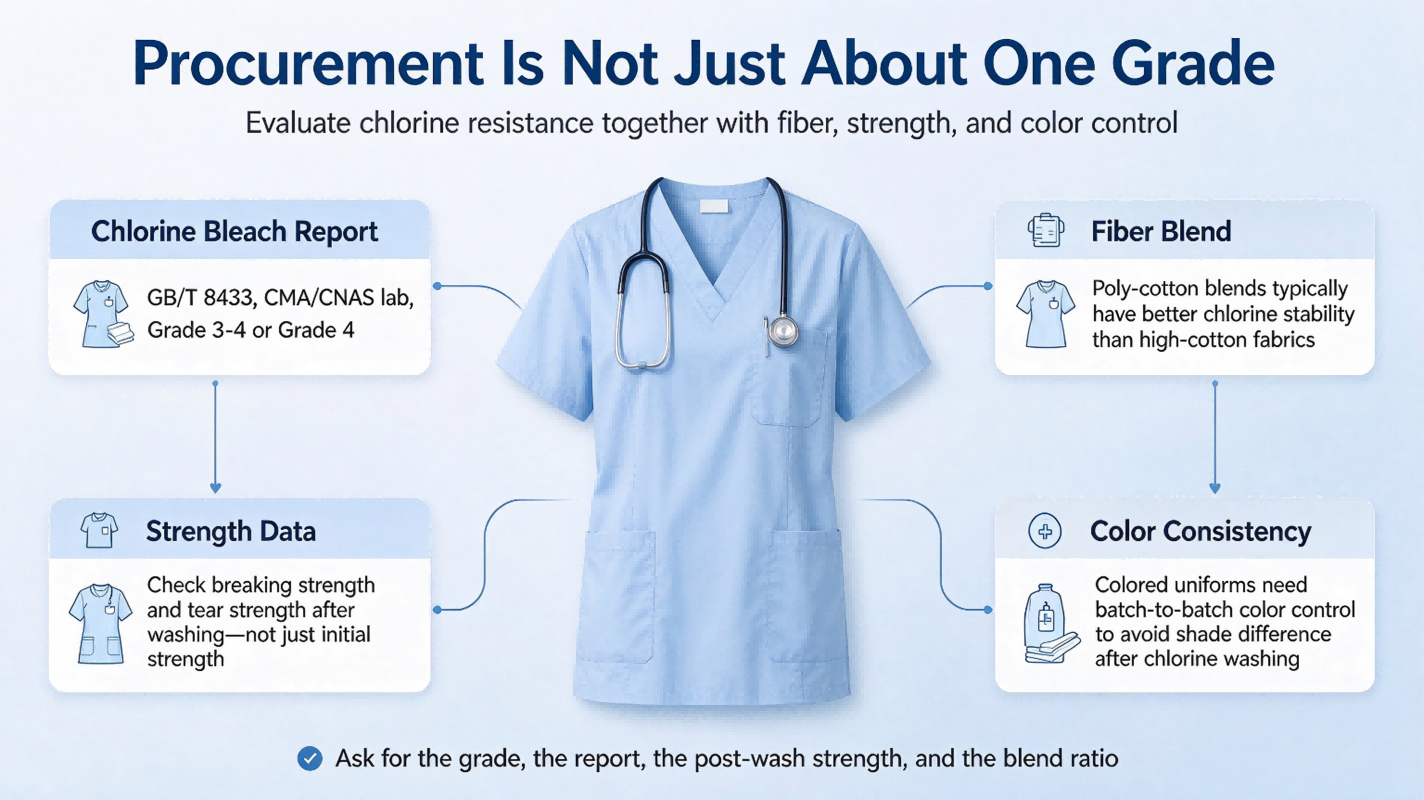
Colour fastness to chlorinated water is a core indicator, but it isn't isolated. During procurement, several indicators need to be considered together.
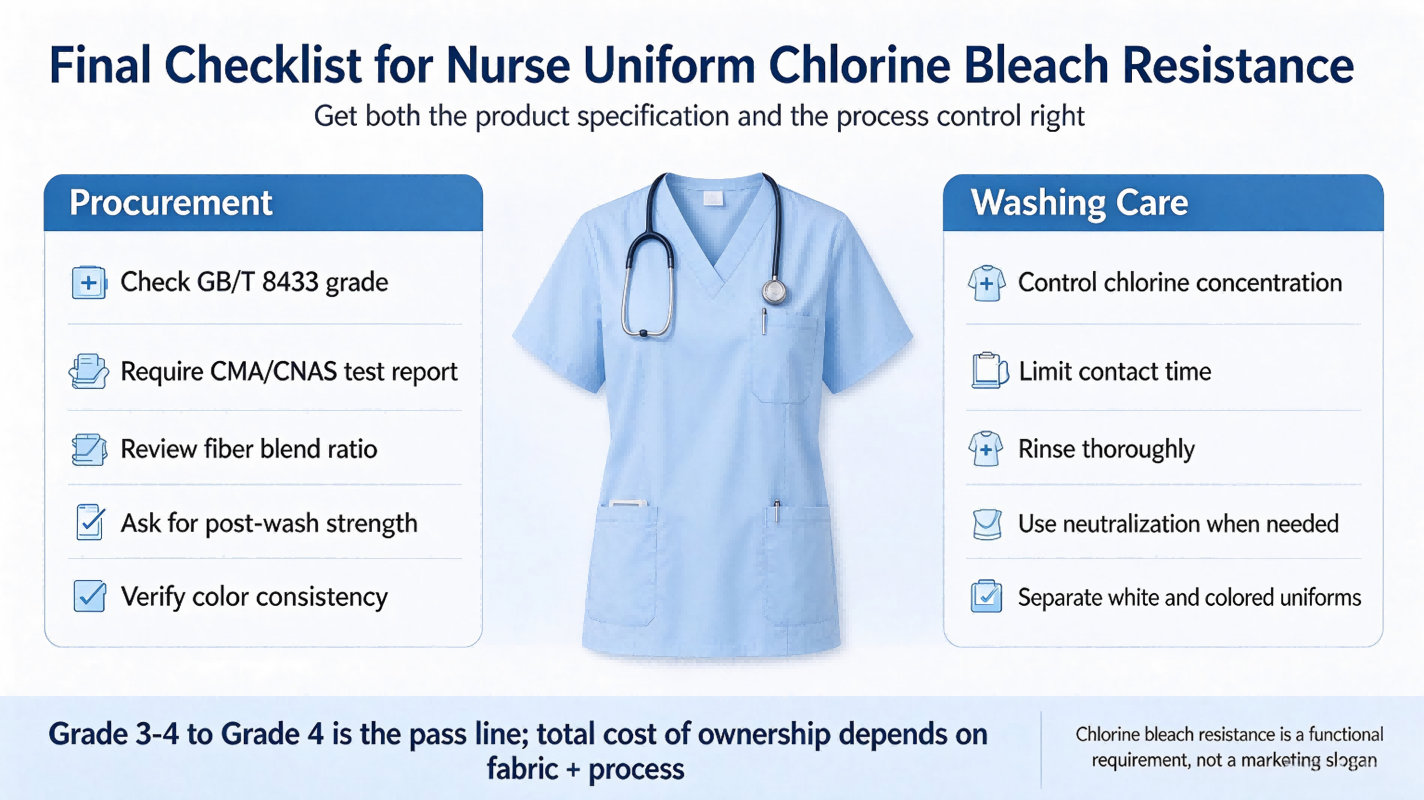
First, the specific grade and test report for colour fastness to chlorinated water. Require the supplier to provide a colour fastness to chlorinated water report issued by a CMA- or CNAS-accredited testing institution according to GB/T 8433, with a grade of at least 3-4, and grade 4 recommended for high-washing-frequency departments. A common requirement in procurement announcements is "chlorine bleach resistance grade 3-4" with an attached test report.
Second, the fibre blend ratio of the fabric. Polyester fibres are significantly more resistant to chlorine-based disinfectants than cotton fibres. Poly-cotton blends (such as 65/35 TC or CVC) typically last longer in chlorine bleach scenarios than high-cotton fabrics. This isn't to say cotton is bad – it's that under the specific condition of chlorine washing, polyester's chemical stability is a more reliable barrier.
Third, breaking strength or tear strength. The ultimate consequence of chlorine bleaching is fibre brittle damage. During procurement, you can ask the supplier for post-wash strength data, not just initial strength. A fabric whose initial strength meets the standard but whose post-wash strength drops sharply has inadequate chlorine bleach resistance.
Fourth, colour difference control for coloured nurse uniforms. In addition to colour fastness to chlorinated water, coloured fabrics also need attention to batch colour difference. Chlorine washing amplifies differences between dyes – if the fabric colour difference within the same batch of nurse uniforms is inconsistent, the shade difference will become more obvious after a few washes.
5. How can washing/care reduce chlorine bleach damage?
Chlorine-bleach-resistant fabric is the "foundation"; washing/care method is the "usage." Even the best chlorine-bleach-resistant fabric will have its lifespan significantly shortened if chlorine disinfectant is used without restraint.
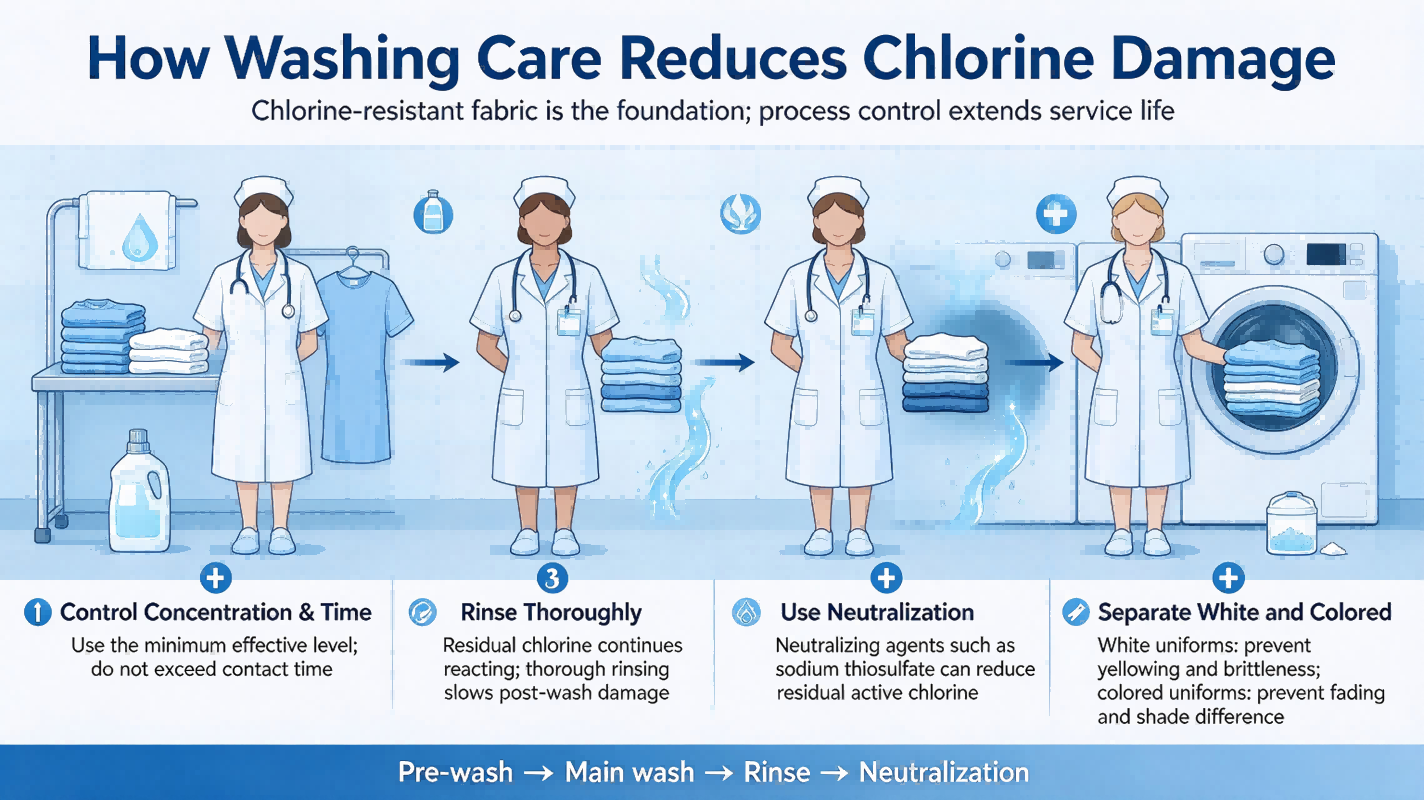
First, control the concentration and exposure time of chlorine disinfectant. WS/T 508—2025 explicitly requires that when selecting chlorine disinfectants, one should "understand in advance whether there is antagonism with the detergent and determine the maximum acceptable level (i.e., the appropriate effective concentration)" – precisely to minimise damage to the fabric. Use just enough concentration – not more; use just enough time to meet disinfection requirements – not longer.
Second, rinse thoroughly after disinfection. Residual chlorine continues to react on the fabric. Incomplete rinsing is equivalent to letting nurse uniforms undergo "slow bleaching" continuously during storage and wear. The WS/T 508—2025 washing process includes four steps – pre-wash, main wash, rinse, and neutralisation – and the neutralisation step is crucial for controlling residual chlorine.
Third, consider using a neutralising agent. Where conditions permit, laundries can use neutralising agents such as sodium thiosulphate in the rinse stage to actively eliminate residual active chlorine and reduce subsequent damage.
Fourth, manage white and coloured uniforms separately. White nurse uniforms focus on preventing yellowing and brittle damage; coloured nurse uniforms focus on preventing fading and colour difference. Coloured nurse uniforms should avoid unnecessary chlorine treatment where possible – where other disinfection methods can be used, give priority to alternatives.
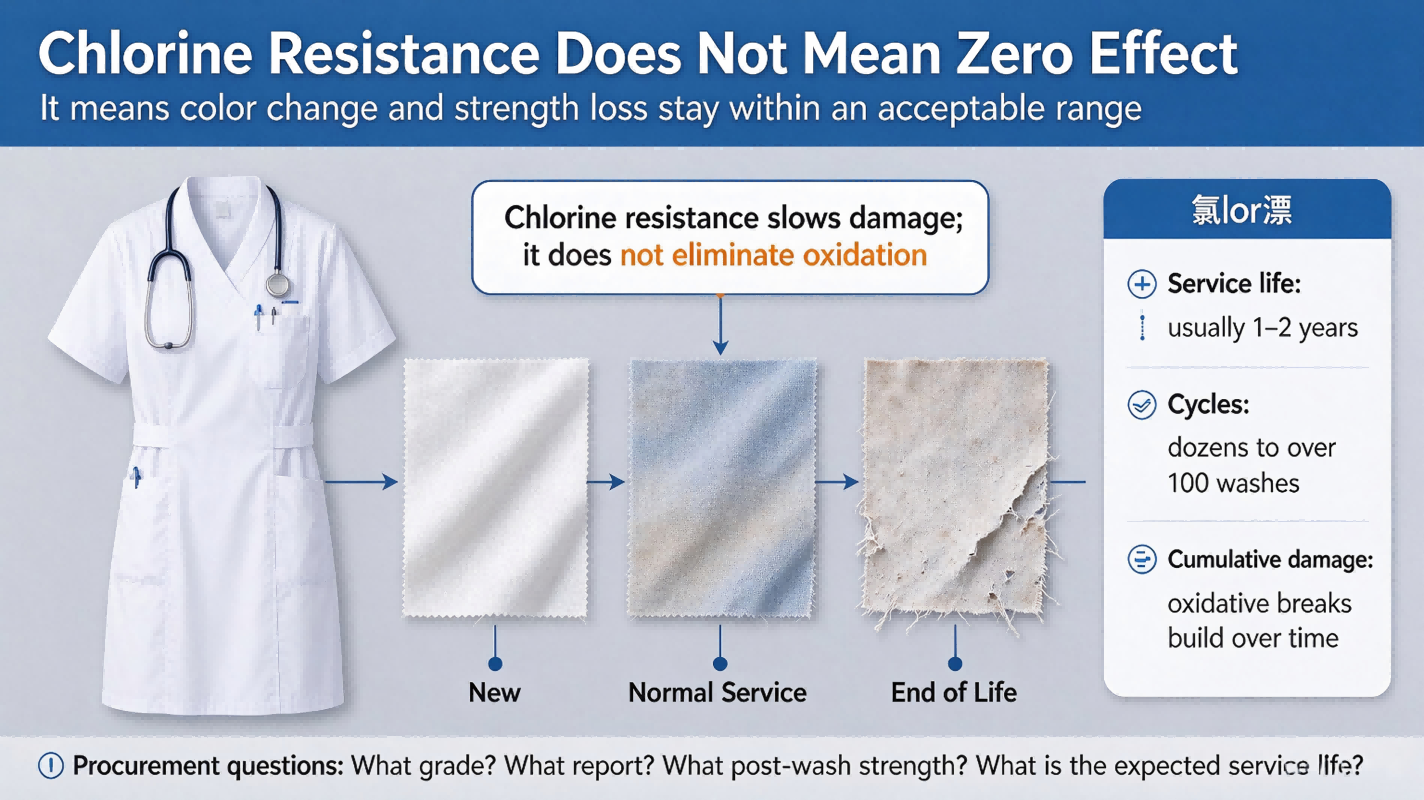
6. A boundary that must be made clear: chlorine bleach resistance does not mean "chlorine has no effect"
"Chlorine bleach resistance grade 4" does not mean "will never be damaged in chlorinated water." Its meaning is: after chlorinated water treatment under specified conditions, colour change and performance degradation remain within an acceptable range.
Nurse uniforms are consumables, and oxidative damage to fibres is cumulative. The significance of chlorine-bleach-resistant fabric is to slow down the rate of damage, so that a nurse uniform maintains usable strength and appearance within its normal service cycle (usually 1 to 2 years, corresponding to dozens to over a hundred washes) – not to "never be damaged."
So during procurement, don't chase the myth of "absolute chlorine bleach resistance." Instead ask: What is the chlorine bleach resistance grade of this fabric? Is there post-wash strength data? Under the washing frequency and chlorine concentration of the target department, how long can it last?
A final honest word
Nurse uniforms require chlorine bleach resistance not because the standard is harsh, but because the real conditions of hospital laundries are chlorine, high temperature, and high frequency. Chlorine oxidises fibres, reduces strength, causes yellowing and fading, and the damage is often "latent" – invisible during washing, exposed during wear.
Grades 3-4 to 4 under GB/T 8433 are the pass line for nurse uniform chlorine bleach resistance. Poly-cotton blends have better chemical stability in chlorine environments than high-cotton fabrics. During procurement, look at the chlorine bleach colour fastness report, post-wash strength data, and fibre blend ratio; during washing/care, control concentration, control time, rinse thoroughly, and neutralise when necessary – get both ends right, and nurse uniforms can hold up and last in a real washing system.
Next time a supplier says "our nurse uniforms are chlorine-bleach resistant," ask them directly: "What grade does GB/T 8433 test at? Can I see the report? Do you have post-wash strength data?" – A supplier who can produce these numbers is a supplier who truly understands that "chlorine bleach resistance" is not just a slogan.