¿Qué estás buscando?


When buying nurse uniforms, the words "anti-static" frequently appear in tender documents and technical specifications, but many buyers understand it only as "not getting shocked in winter." The anti-static performance of a nurse uniform is far more than just preventing a nurse from getting a little zap.
In operating rooms, ICUs, and departments dense with electronic instruments, static on nurse uniforms can interfere with the operation of precision equipment and, under certain conditions, even become an ignition source. Meanwhile, a large number of nurse uniforms labelled "anti-static" on the market have not actually passed real standard testing—some have just a few conductive threads scattered in the fabric, some fail after a few washes, and some even use insulating sewing thread.
Today, we're going to explain anti-static nurse uniforms clearly—what risks static poses in hospitals, which departments are must-have scenarios, what the GB 12014 standard governs, and how to avoid the pitfalls of "fake anti-static" during procurement.
1. Why can't static in hospitals be treated as a "minor issue"?
In everyday life, static at most gives you a little shock. But in a hospital environment, the risks posed by static are layered.
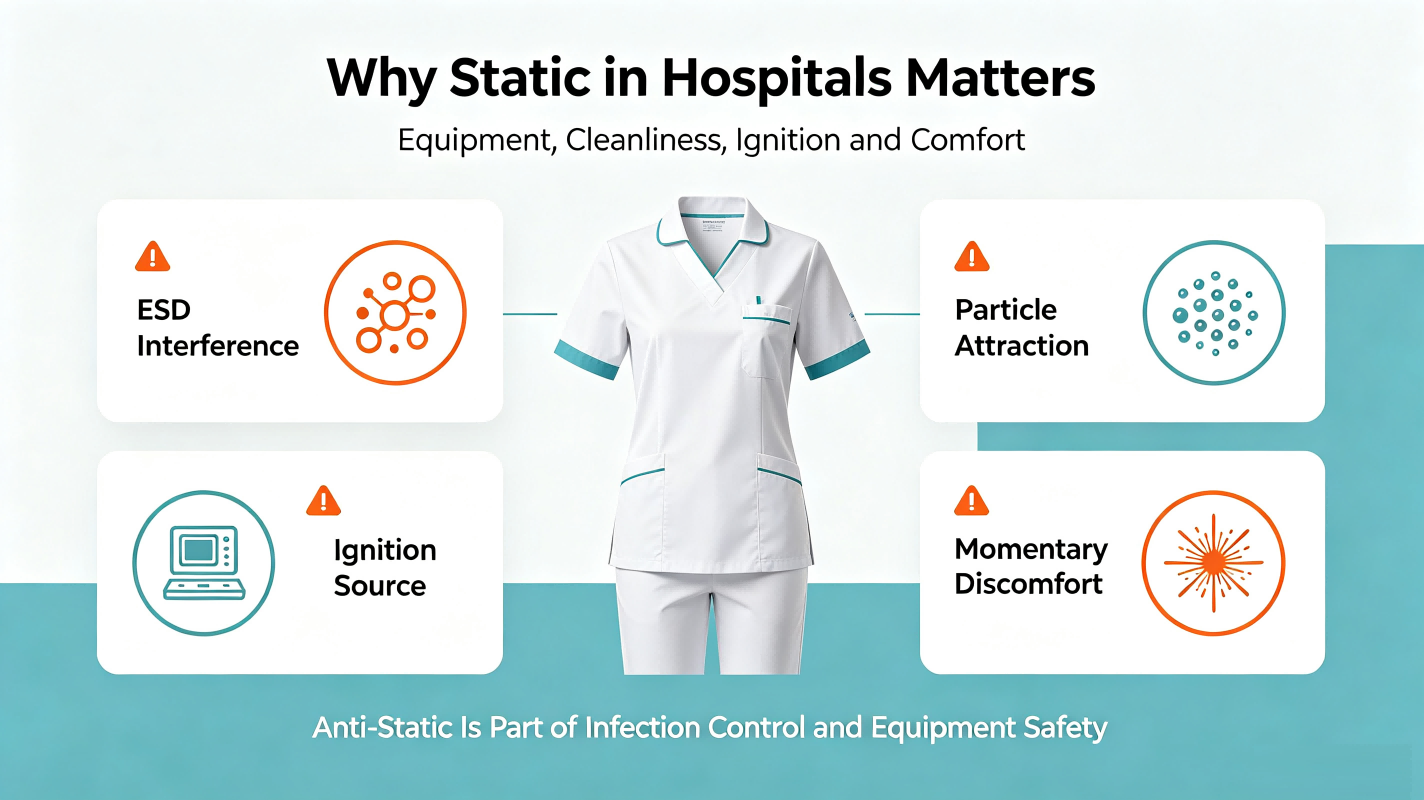
First layer of risk: interfering with precision medical equipment.
Operating rooms, ICUs, catheterization labs, and clinical laboratories are densely packed with precision equipment—monitors, anaesthesia machines, infusion pumps, electronic endoscopes, and more. These devices are highly sensitive to electrostatic discharge (ESD). Static can cause reading drift, signal interruption, or even component damage. During an ongoing surgery, the consequences of equipment readings becoming distorted are not something that can be solved by "just restarting it."
Second layer of risk: attracting particles and disrupting clean environments.
One physical property of static is attraction. If static accumulates on the surface of a nurse's uniform, it will attract dust, skin flakes, bacteria, and other particles from the air onto the fabric, which then spread to clean areas or around patients as the wearer moves and works. For sterile wards and laminar flow operating rooms, this particle transfer is a variable that needs to be eliminated in the infection control system. Studies have shown that isolation gowns and nurse uniforms using conductive fibres to control electrostatic fields can reduce bacterial transfer by 10 to 15 times compared with ordinary nurse uniforms.
Third layer of risk: igniting flammable gases or vapours.
Some anaesthetic gases used in operating rooms are flammable. If gas accumulates in the air, a tiny static spark could become an ignition source. Although modern anaesthetic gas management is very strict, "eliminating all potential ignition sources" remains a basic principle of operating room safety. This is also why some hospital regulations explicitly require that operating room staff clothing "should use all-cotton products" or be equipped with anti-static discharge devices.
Fourth layer of risk: static accumulating on the human body, causing discomfort and secondary accidents.
The static voltage accumulated by nurses through walking and friction can reach several thousand volts. Apart from physical discomfort during discharge, it can also cause momentary muscle contraction or a startle response. In scenarios such as transferring patients or operating instruments, this momentary reaction poses a safety hazard.
2. Which departments are "must-have scenarios" for anti-static nurse uniforms?
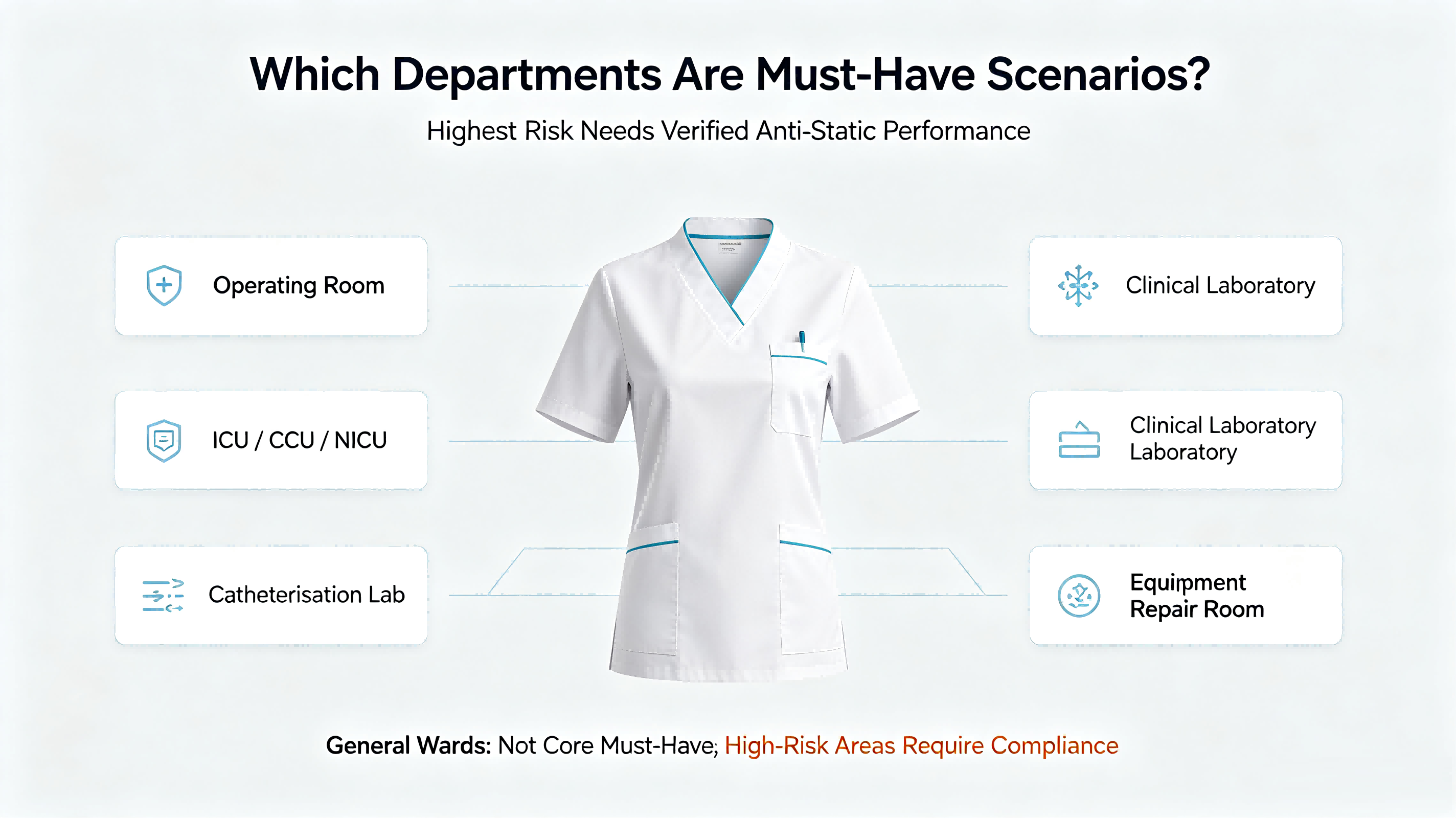
Not all departments need high-grade anti-static nurse uniforms, but the following types of departments have the highest must-have level.
Operating rooms, post-anaesthesia care units – densely packed with precision electronic equipment and with flammable anaesthetic gas risks, this is the scenario with the clearest anti-static requirement.
ICU, CCU, NICU – densely packed with monitoring equipment, ventilators, and infusion pumps; patients are critically ill, and both equipment signal stability and infection control requirements are high.
Catheterisation labs, endoscopy centres, imaging departments – large amounts of electronic imaging and interventional equipment, sensitive to electrostatic discharge.
Clinical laboratories, labs, pharmacy intravenous admixture centres – precision analytical instruments and clean operating environments; static attraction can interfere with testing and dispensing.
Electronic medical equipment repair rooms, equipment departments – direct contact with electronic components; anti-static is a basic requirement.
For general wards, outpatient departments, and administrative roles, anti-static is not a core must-have, but nurse uniforms with anti-static performance can still improve wearing comfort and reduce attraction during dry seasons.
3. What does GB 12014-2019 govern? Four core indicators
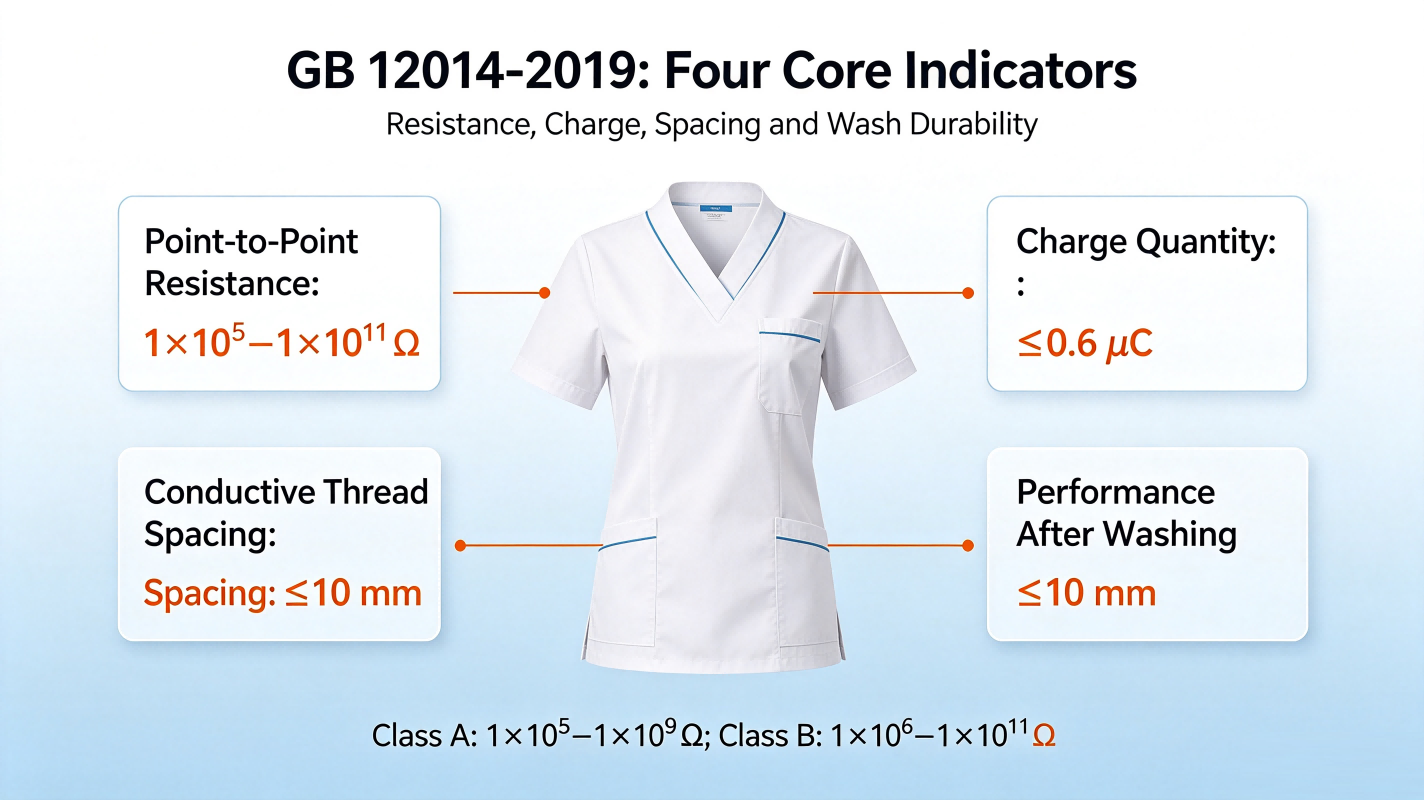
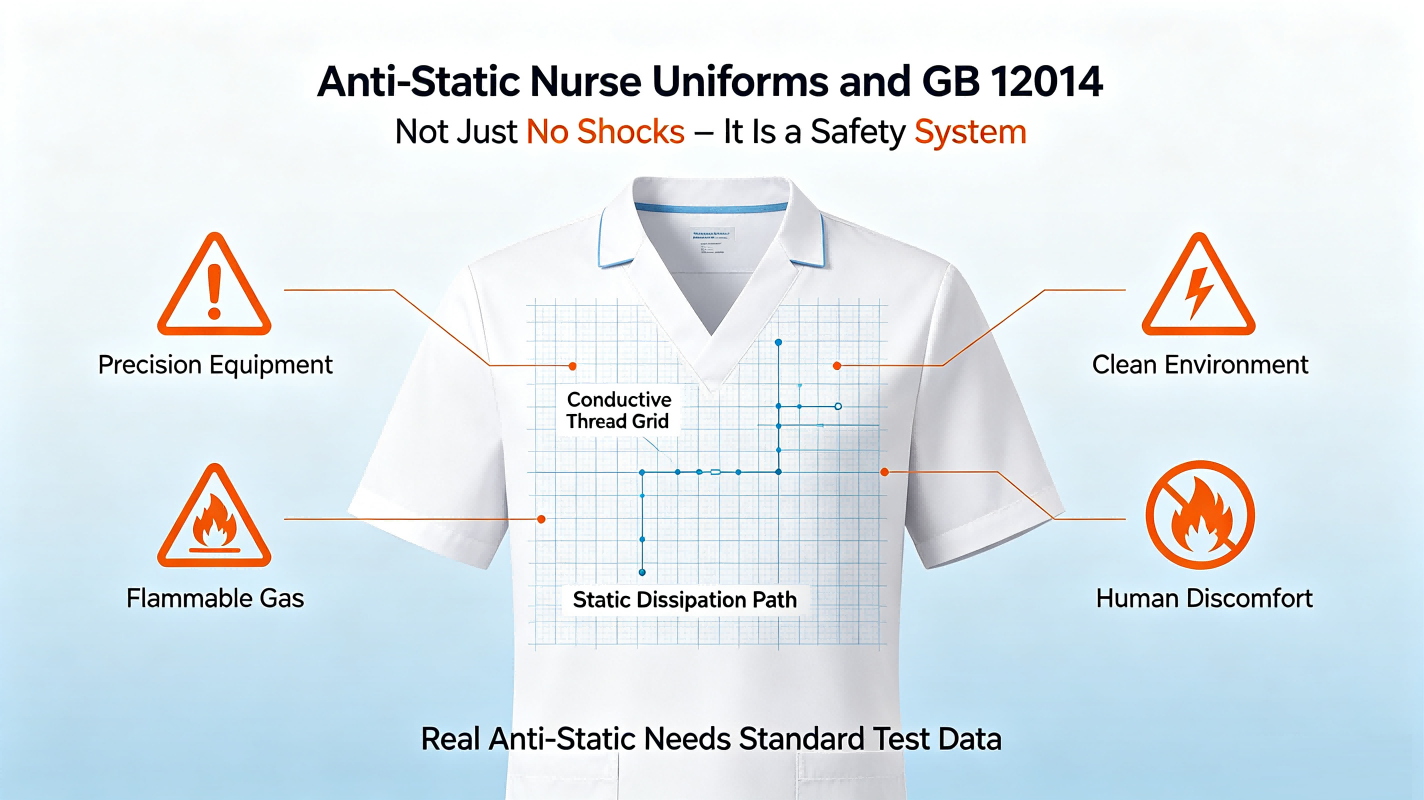
The basis for anti-static performance of nurse uniforms is GB 12014-2019 "Protective clothing – Anti-static clothing", a mandatory national standard. What it assesses is not "whether there are conductive threads," but whether the conductive path is effective, whether it withstands washing, and whether it is safe.
Indicator 1: Point-to-point resistance – 1×10⁵ Ω to 1×10¹¹ Ω
This is the most core physical indicator of anti-static fabric. The standard requires point-to-point resistance to fall between 1×10⁵ Ω and 1×10¹¹ Ω.
Why is there a lower limit? Because the goal of anti-static clothing is to slowly leak static, not to become a conductor. Resistance below 1×10⁵ Ω actually increases the risk of electric shock in live-working or accidental power contact scenarios; resistance above 1×10¹¹ Ω means static cannot be effectively dissipated, making it equivalent to ordinary fabric.
The standard divides anti-static clothing into Class A and Class B: Class A point-to-point resistance is 1×10⁵ to 1×10⁷ Ω, Class B is 1×10⁷ to 1×10¹¹ Ω. Hospital nurse uniforms generally correspond to Class B to meet requirements, but the specific class needs to be determined based on departmental risk assessment.
Indicator 2: Charge quantity – ≤0.6 μC
This indicator simulates the static accumulation generated by human body friction during activity. The test method involves placing the garment in a tumble friction machine to rub against standard cloth, then measuring the charge on the garment. GB 12014 requires the charge quantity of each anti-static garment to be less than 0.6 μC.
What does 0.6 μC mean? In flammable gas environments, static discharge energy exceeding a certain threshold can become an ignition source. The 0.6 μC limit is precisely to keep discharge energy within safe boundaries.
Indicator 3: Conductive thread spacing – ≤10 mm
This is the only indicator that can be preliminarily judged on-site with the naked eye and a ruler. The standard stipulates that for fabrics using stripe or grid conductive fibres to achieve anti-static performance, the spacing of conductive material must not exceed 10 mm.
Spacing exceeding 10 mm means the density of the conductive path is insufficient, the fabric structure itself does not comply with the standard, and subsequent washing tests and performance data lose their meaning. During procurement, if you can only look at a fabric sample, measuring the grid spacing with a ruler is more direct than listening to any marketing pitch.
Indicator 4: Performance after washing – "new fabric passing" is not the end of the story
GB 12014-2019 assesses anti-static performance after washing. Samples need to undergo standard washing and conditioning to simulate the state after repeated use, then be tested for resistance and charge quantity.
This is the most easily manipulated link in anti-static nurse uniform procurement. New garments have intact conductive threads and produce good test data; after a dozen or so washes, conductive fibres break, resistance skyrockets, and protection effectively fails. So when looking at a test report, you must turn to the test conditions section and confirm whether the data is "post-wash" or "pre-wash." In industry practice, qualified anti-static clothing should still meet the limit requirements after at least 50 standard washes.
4. The three most common pitfalls in buying anti-static nurse uniforms
Pitfall 1: Only looking at "has conductive threads," not spacing or reports.
A few black conductive threads are woven into the fabric, the grid is sparse, spacing is visibly over 1 cm, and the supplier cannot produce a third-party test report according to GB 12014-2019. This type of "threads but no standard" product is non-compliant in the face of the standard.
Anti-pitfall action: Require the supplier to provide a test report issued by a CMA- or CNAS-accredited institution according to GB 12014-2019, focusing on post-wash point-to-point resistance and charge quantity. At the same time, measure the conductive thread spacing on site; anything exceeding 10 mm is immediately excluded.
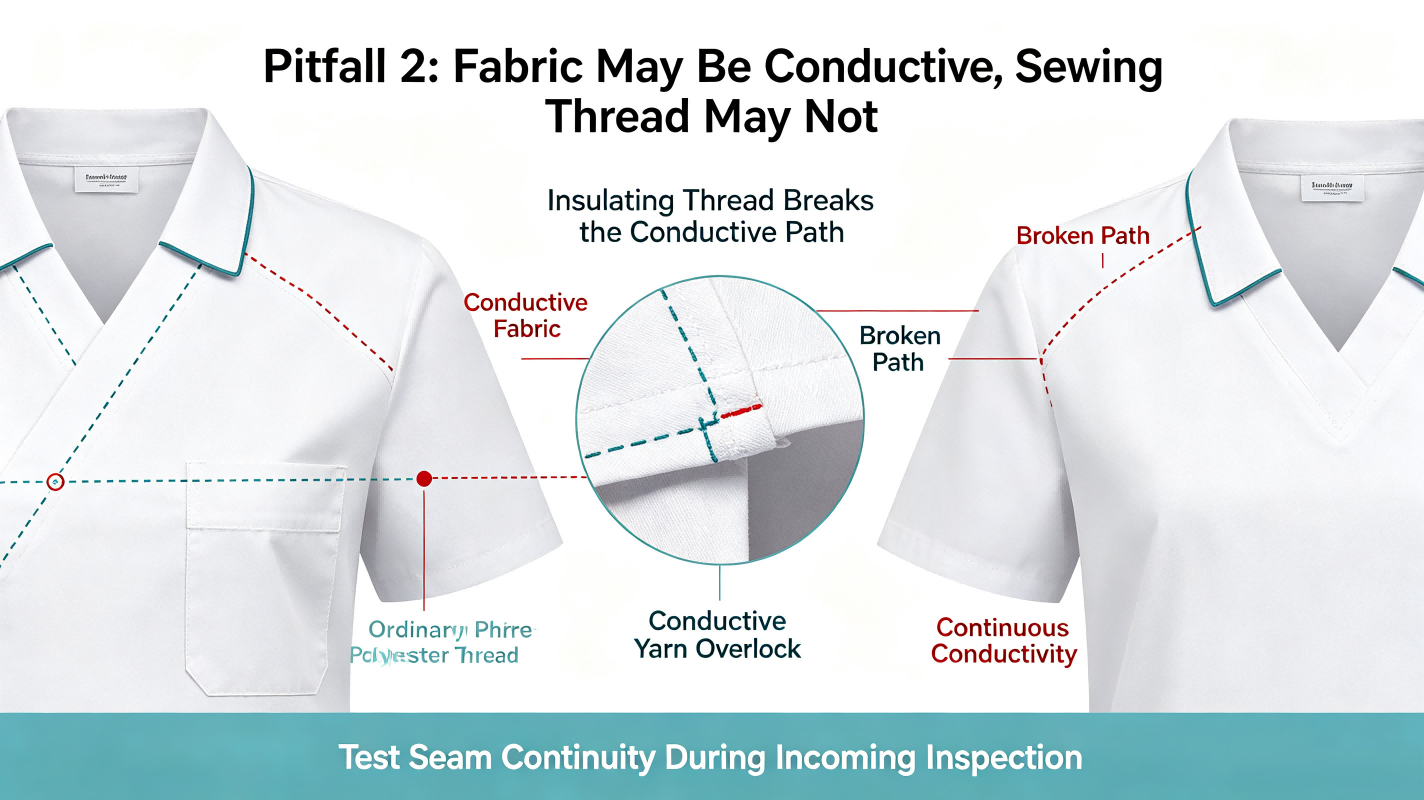
Pitfall 2: The fabric is anti-static, but the sewing thread is not.
This is a very hidden but serious problem. About 37% of low-priced "fake anti-static clothing" only embeds conductive threads in the fabric layer, while the sewing thread joining the garment panels is still ordinary polyester thread. This means that at stress concentration points such as cuffs, collars, and shoulder seams, the conductive path is cut off by insulating sewing thread, and static generated by human activity accumulates at these "breakpoints" and cannot be effectively dissipated.
Anti-pitfall action: Explicitly require in the contract that sewing thread has continuous conductivity, using conductive yarn overlock, with sewing thread resistance controlled within the standard range. During incoming inspection, test not only the fabric but also the conductive continuity at seams.
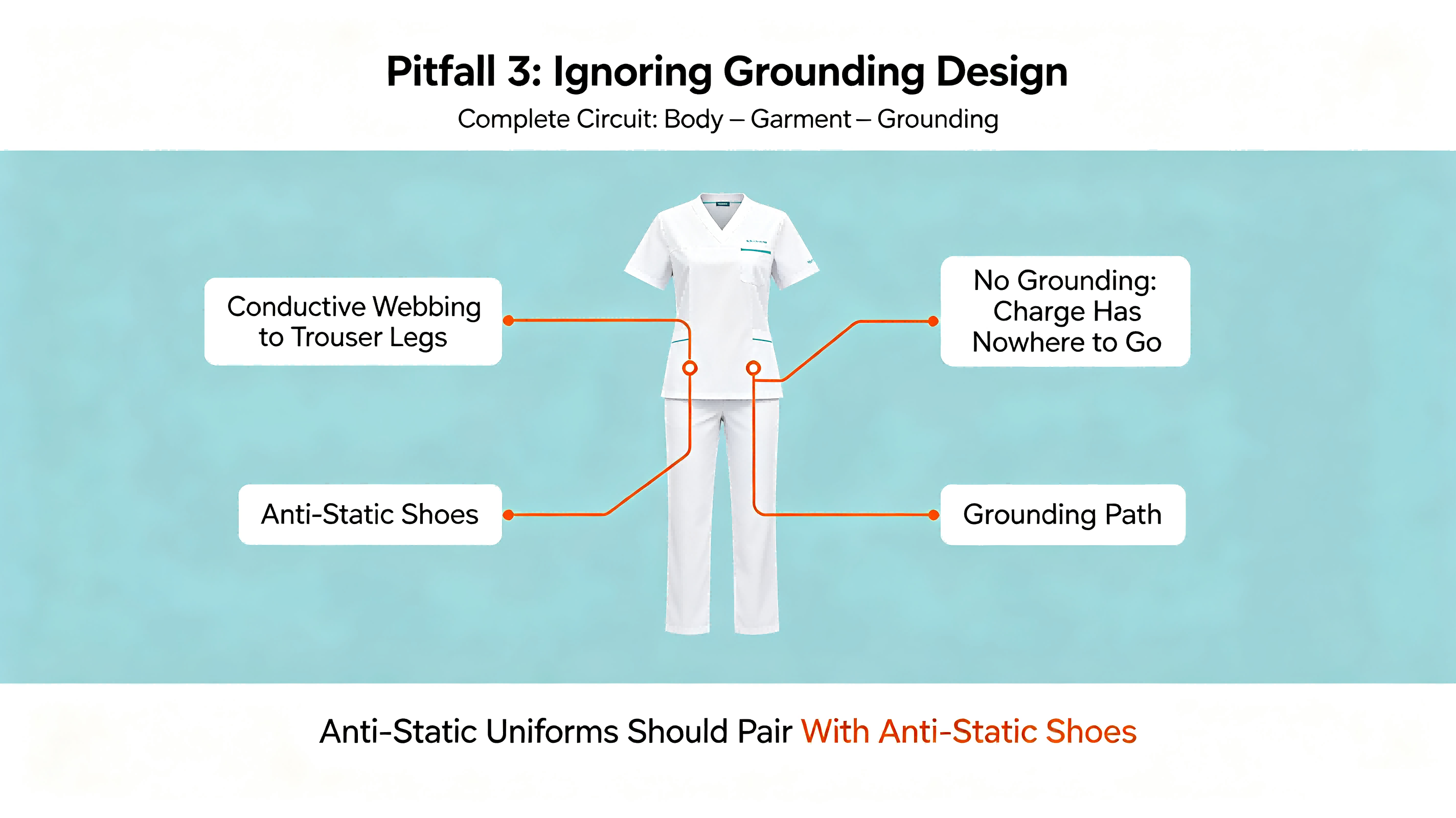
Pitfall 3: Ignoring grounding design.
For anti-static clothing to form a complete static discharge path, a closed loop of "human body – clothing – grounding" is required. If the nurse's uniform has no grounding point, no matching anti-static shoes or grounding path, even if the fabric resistance meets the standard, the accumulated charge has nowhere to go, and the protection system is incomplete.
Anti-pitfall action: Confirm whether the supplier's anti-static solution includes grounding path design (such as conductive webbing extending to the trouser legs, used with anti-static shoes). In must-have departments such as operating rooms and ICUs, anti-static nurse uniforms should be purchased together with anti-static shoes to form a complete circuit.
5. Washing and care of anti-static nurse uniforms: use it wrong, and it's as good as not buying it
Anti-static performance is "washed in," and it is also "washed away."
First, absolutely no fabric softener. Fabric softener forms an insulating film on the surface of conductive fibres, directly blocking the charge dissipation path. This is the number one taboo in the care of anti-static nurse uniforms.
Second, water temperature not exceeding 40℃, neutral detergent. High temperature and strongly alkaline detergents accelerate the ageing and breakage of conductive fibres.
Third, avoid chlorine bleach. Chlorine-based disinfectants cause oxidative damage to both conductive fibres and base fabric, accelerating the degradation of anti-static performance.
Fourth, retest regularly. Anti-static performance degrades cumulatively with washing and wear. It is recommended to retest surface resistance or charge quantity every 6 to 12 months for anti-static nurse uniforms in use; departments with high washing frequency should shorten the cycle. If resistance is found to exceed the standard range, replace promptly – don't "wear it until it falls apart."
A final honest word
Anti-static nurse uniforms, in departments such as operating rooms, ICUs, catheterisation labs, and clinical laboratories, are a link in the infection control and equipment safety system, not an optional bonus. The four numbers given by GB 12014-2019 – point-to-point resistance 1×10⁵ to 1×10¹¹ Ω, charge quantity ≤0.6 μC, conductive thread spacing ≤10 mm, and performance still meeting the standard after washing – are the hard thresholds for judging whether an anti-static nurse uniform "is actually useful."
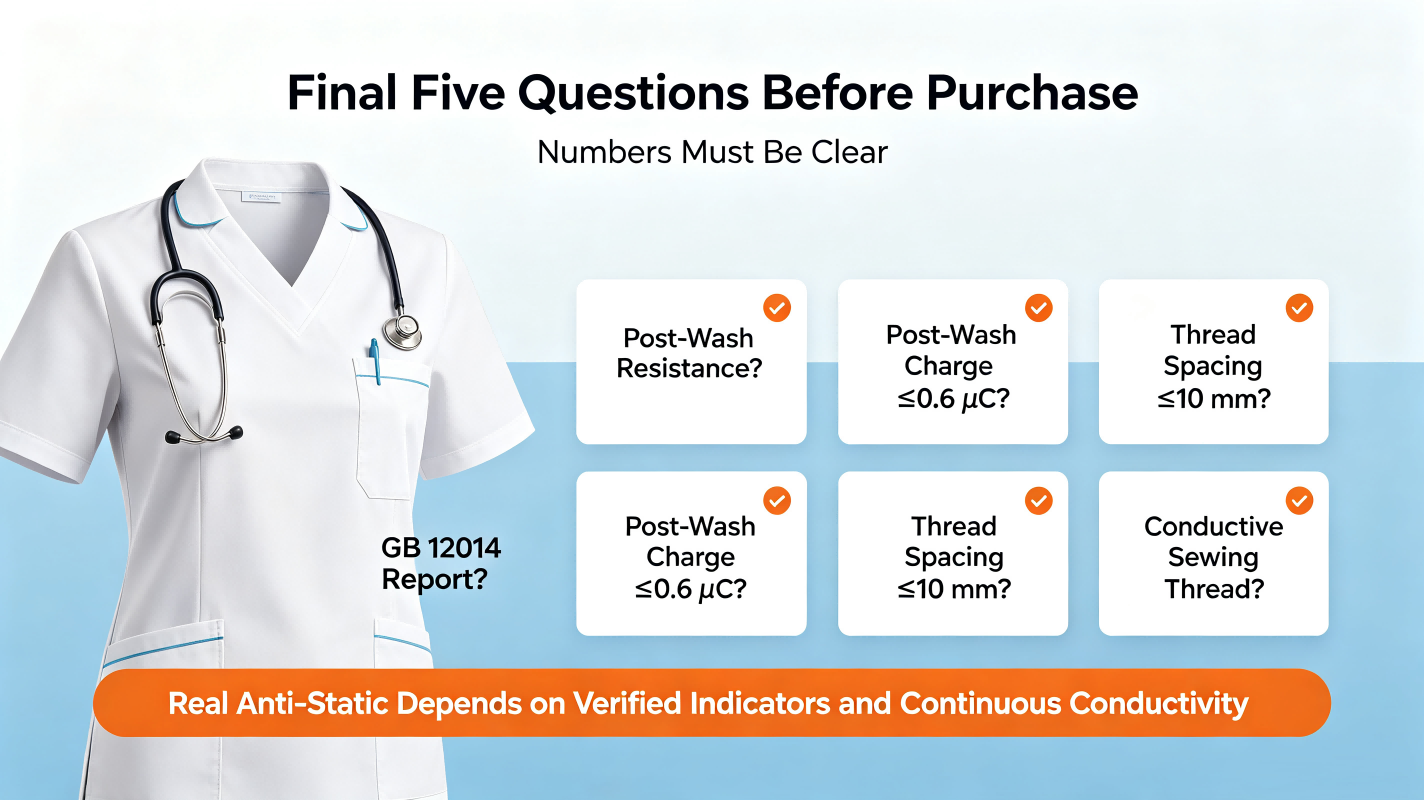
When buying, don't just ask "Is it anti-static?" Ask directly: "Do you have a GB 12014 report? What is the measured post-wash point-to-point resistance? What is the post-wash charge quantity? What is the conductive thread spacing? Is the sewing thread conductive?" – A supplier who can present these numbers and details is genuinely making anti-static nurse uniforms, not selling an ordinary workwear garment that "looks like it has black threads."