¿Qué estás buscando?


When buying nurse uniforms, many people overlook one detail – whether the fabric is see-through.
If a white nurse uniform is too thin or too loosely woven, the outline of undergarments can show through. The nurse feels awkward, and patients and families see it as unprofessional. Coloured nurse uniforms are somewhat better, but if they're too sheer, they also affect professional appearance. What's worse, some nurse uniforms aren't see-through when new, but become more and more sheer after washing – the fabric gets thinner and looser, and the problem emerges.
Whether a nurse uniform is see-through isn't something that can be explained by "thick or not" alone. Behind it is the combined effect of fabric density, yarn count, fabric weight, weave structure, and opacity finishing. Today we're going to explain this from start to finish – why fabric becomes see-through, which indicators determine opacity, how to judge it during procurement, and how to prevent it from getting more sheer with washing.
1. First, understand: why are nurse uniforms see-through?
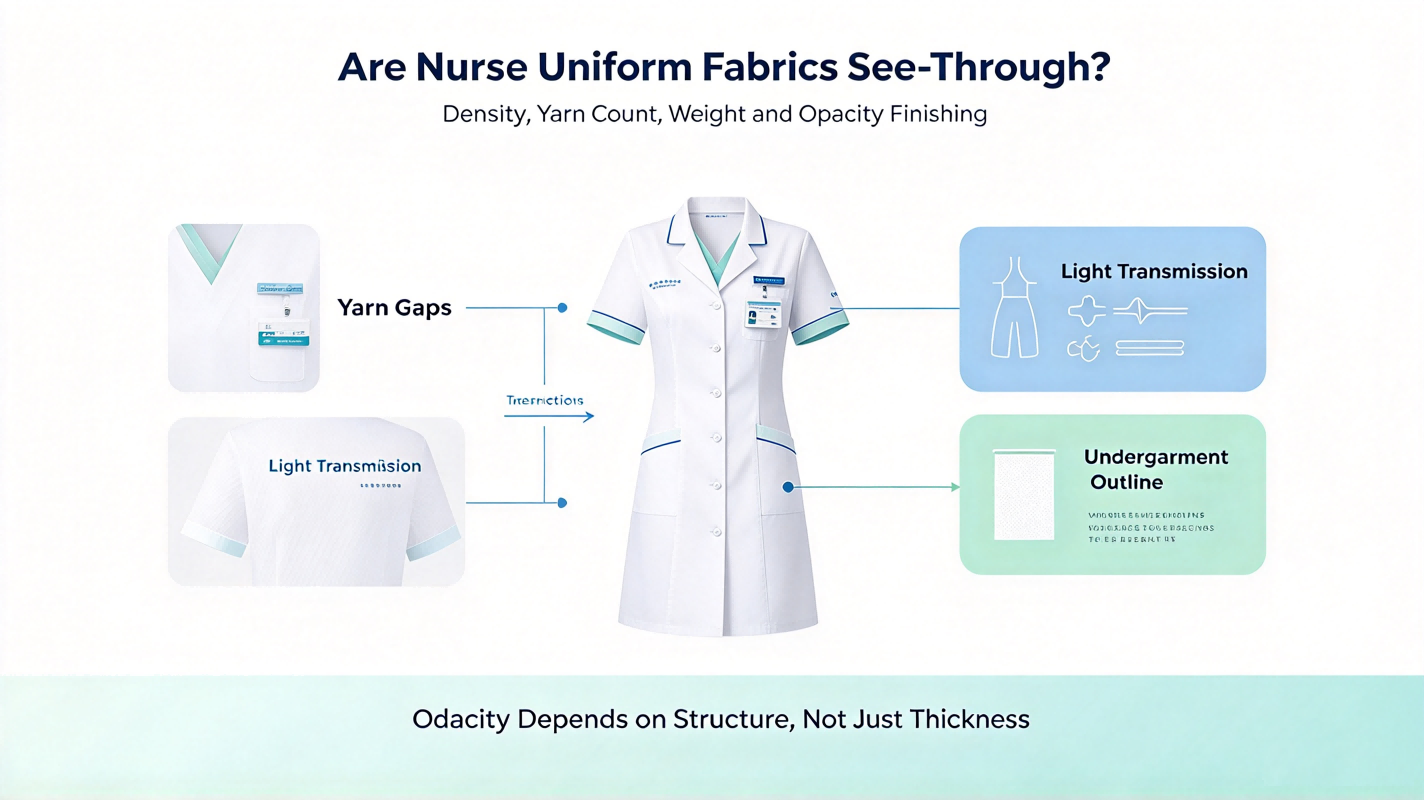
Fabric is translucent because light passes through the gaps between yarns. The larger and more uniform the gaps, the more obvious the translucency.
Whether a nurse uniform is see-through mainly depends on four factors:
First, the size of the gaps between yarns. The finer the yarn and the looser the weave, the larger the gaps, and the more see-through the fabric.
Second, fabric density. Density is the number of warp and weft yarns per square inch. The lower the density, the sparser the yarn arrangement, and the more obvious the translucency.
Third, fabric colour. White and light-coloured fabrics have weaker light-blocking ability. At the same density, they appear more see-through than dark fabrics. This is why white nurse uniforms have the highest opacity requirements.
Fourth, structural changes after washing. Fabric gets thinner and looser with repeated washing. The gaps between yarns become larger, and a uniform that wasn't see-through at first may become sheer after a few washes.
So opacity in nurse uniforms isn't achieved by "making it thicker" alone. It must be considered from density, yarn count, weave structure, and finishing together.
2. Density: the first threshold determining opacity
What is density?
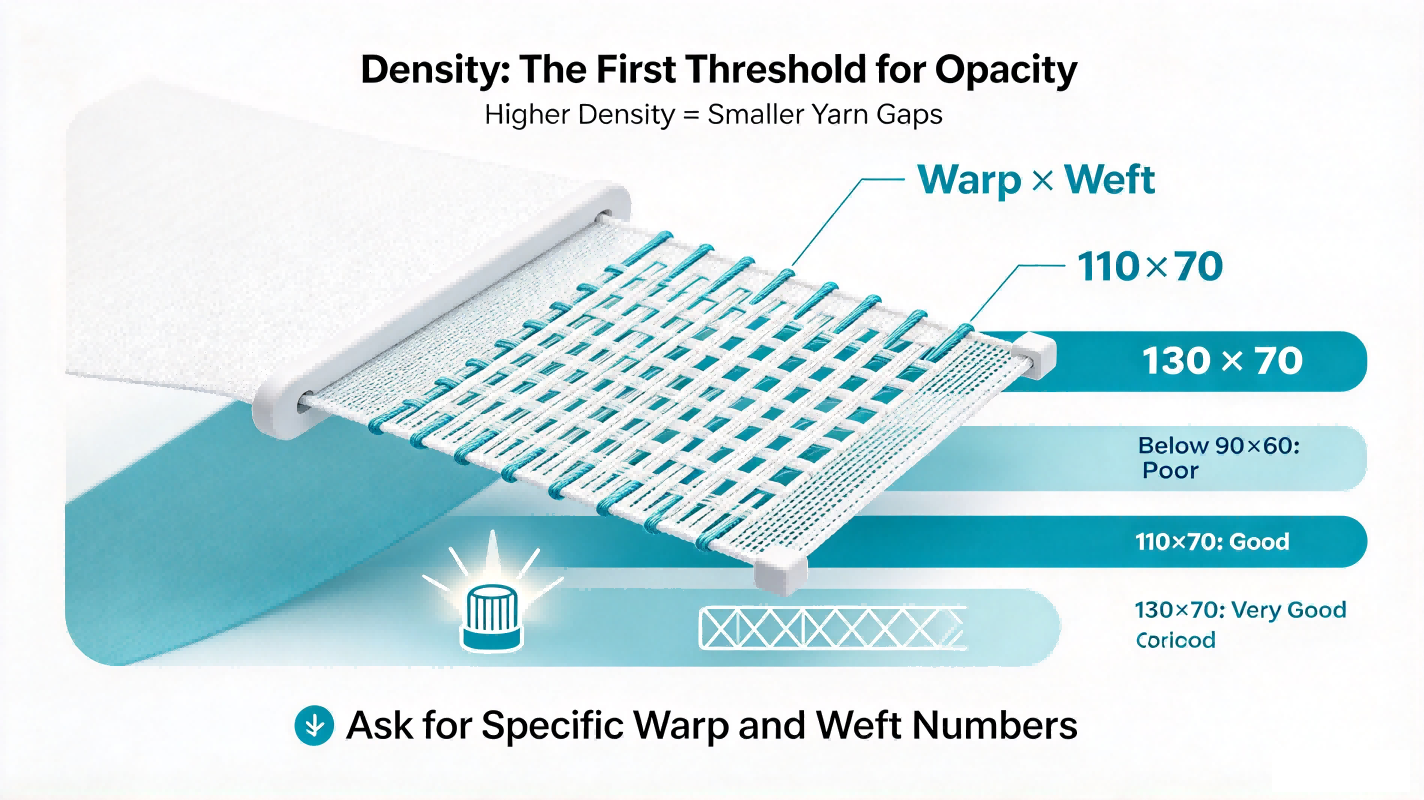
Density is the number of warp and weft yarns per square inch of fabric, usually written as "warp × weft," for example 110×70, meaning 110 warp yarns and 70 weft yarns per square inch.
The higher the density, the tighter the yarn arrangement, the smaller the gaps between yarns, and the less see-through the fabric. The lower the density, the sparser the yarns, and the more obvious the translucency.
Common density ranges for nurse uniforms:
|
Density (warp × weft) |
Fabric characteristics |
Opacity |
|
Below 90×60 |
Sparse, light |
Poor – white versions are easily see-through |
|
100×60 |
On the sparse side |
Fair – needs higher weight to compensate |
|
110×70 |
Regular, balanced |
Good – white versions are basically opaque |
|
130×70 |
Tight, crisp |
Good – strong opacity |
|
133×72 and above |
High density |
Very good – but stiffer hand-feel and higher cost |
How to check density?
During procurement, don't just ask "Is the fabric thick?" Ask directly: "What's the warp and weft density?" A legitimate supplier can give you specific numbers. If they only say "our fabric is very dense" but can't give the yarn count per inch, that's a red flag.
A simple way to judge: Hold the fabric up to a light source. If the light comes through very evenly and brightly, density is on the low side. If the light is weaker and you can clearly see the warp and weft interlacing texture, density is higher.
Note: Higher density isn't always better. Too high and the fabric becomes stiff, breathability drops, and nurses feel uncomfortable. Nurse uniform density is generally best between 110×70 and 130×70, balancing opacity, hand-feel, and breathability.
3. Yarn count: finer yarn isn't necessarily more see-through – it depends on the combination
What's the relationship between yarn count and opacity?
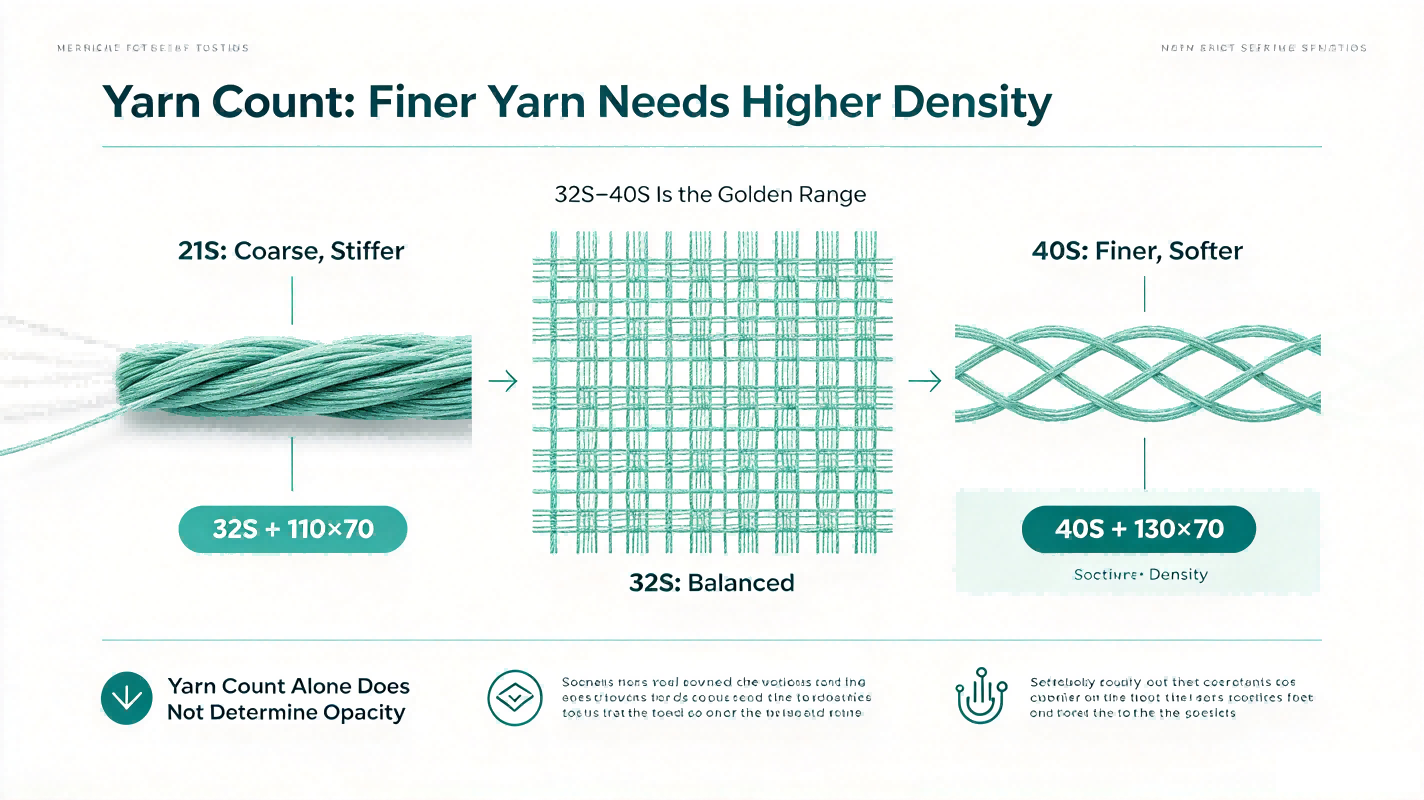
Yarn count is an indicator of yarn thickness. The higher the count, the finer the yarn; the lower the count, the coarser the yarn.
Many people assume "the higher the yarn count, the more see-through." That's not entirely true. High count means fine yarn. If density stays the same, the gaps between yarns do become larger, and the fabric is more see-through. But high-count yarn is usually used with higher density – "fine yarn + high density" achieves both softness and opacity.
Conversely, low-count yarn is coarse, and a single yarn has stronger light-blocking ability. But low-count fabrics usually feel stiffer and have higher weight, so comfort is worse.
Common yarn count ranges for nurse uniforms:
|
Yarn count |
Yarn characteristics |
Opacity characteristics |
Suitable scenarios |
|
21S |
Coarse |
Strong single-yarn blocking, but fabric is stiff |
Low-end workwear, thick outerwear |
|
32S |
Medium |
Balanced – needs density to match |
Regular nurse uniforms |
|
40S |
Finer |
Needs higher density for opacity |
Mid-to-high-end nurse uniforms |
|
60S and above |
Very fine |
Must have high density + opacity finishing |
High-end next-to-skin garments |
The golden combination for nurse uniforms: 32S to 40S, with density of 110×70 to 130×70.
32S + 110×70 is the most common configuration for regular nurse uniforms – opacity is sufficient, and hand-feel is balanced. 40S + 130×70 is finer, softer, and more opaque, but costs more.
What to ask during procurement?
Ask: "What's the yarn count? What's the density?" Ask for both numbers together. Asking only yarn count without density, or only density without yarn count, won't tell you the opacity.
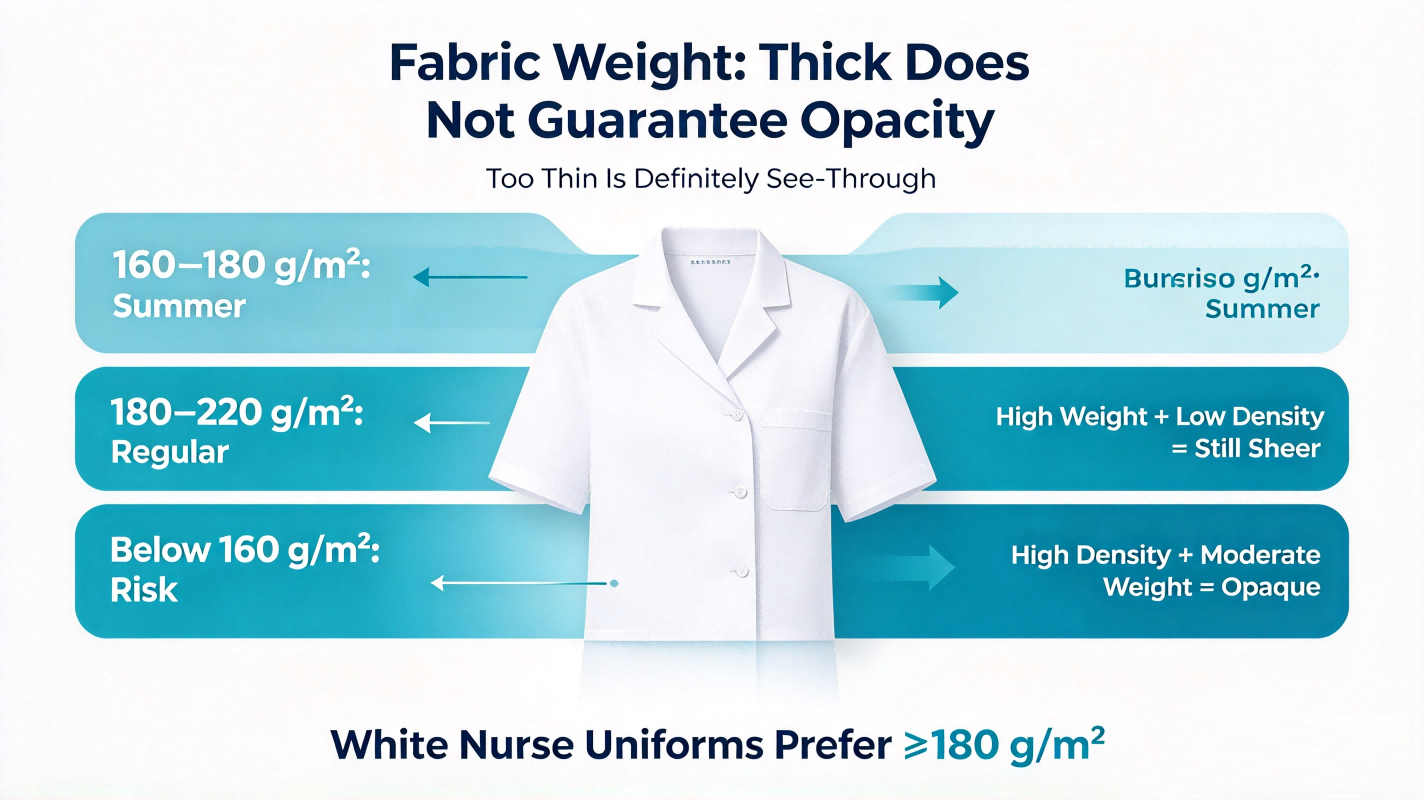
4. Fabric weight: thick doesn't guarantee opacity, but too thin is definitely see-through
Fabric weight is the weight per square metre, in g/m². Weight is related to opacity, but it isn't the only factor.
At the same density, heavier fabric is usually thicker and more opaque. But high weight doesn't guarantee opacity – if the yarn is coarse and density is low, the fabric may be thick but the gaps between yarns are large, and it will still be see-through.
Common nurse uniform weights range from 180–220 g/m². For summer, lighter versions of 160–180 g/m² can be used, but white versions should not go below 180 g/m², otherwise opacity is hard to guarantee.
A rule of thumb: If a white nurse uniform weighs less than 160 g/m², you can basically conclude its opacity is weak and needs to be compensated by density and opacity finishing. If both weight and density are on the low side, that uniform will definitely be see-through.
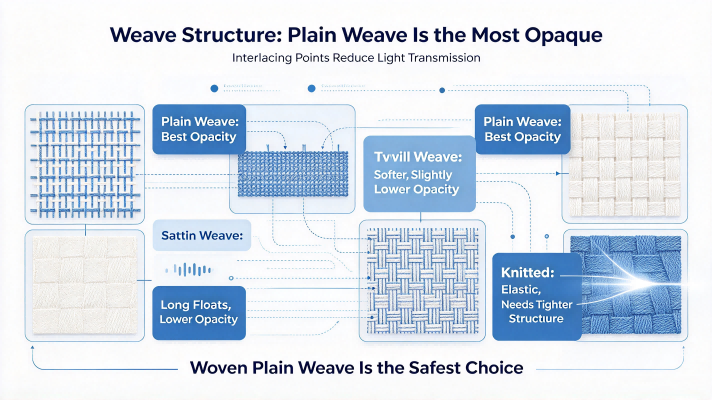
5. Weave structure: plain weave is the most opaque; twill and satin depend on parameters
The weave also affects light transmission.
Plain weave: Warp and weft yarns interlace one over one – the most interlacing points, the tightest yarn arrangement, and the best opacity. Most nurse uniforms use plain weave or plain-weave variations.
Twill weave: Warp and weft interlace two over one – fewer interlacing points than plain weave, longer floats, softer hand-feel, but at the same density, opacity is slightly lower than plain weave.
Satin weave: The longest floats, smooth and soft surface, but larger gaps between yarns – the weakest opacity. Nurse uniforms rarely use pure satin weave.
Knitted fabric: Knitted structures are elastic and comfortable to wear, but the loop structure naturally has gaps, and opacity is usually inferior to woven plain weave. If a nurse uniform is knitted, it needs higher weight or tighter knitting to ensure opacity.
During procurement, you can ask: "Is it woven or knitted? What weave structure?" Woven plain weave is the safest choice for nurse uniform opacity.
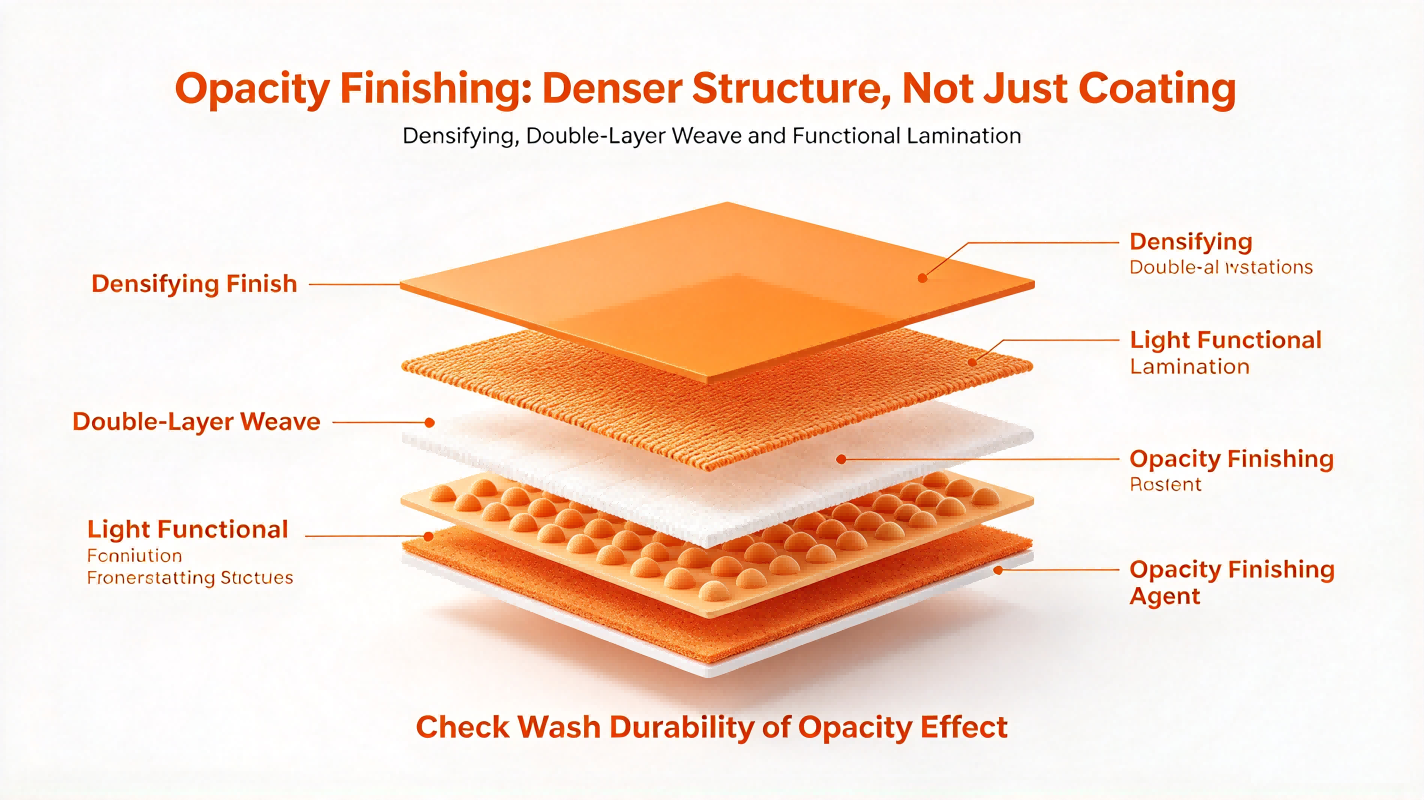
6. Opacity finishing: not "coating," but making the fabric denser
Besides physical indicators like density, yarn count, and weight, fabric can also receive opacity finishing.
Common opacity finishing methods include:
First, densifying finish. Post-finishing causes yarns to shrink and pack more tightly, reducing the gaps between yarns. This doesn't change fabric composition – it just makes the structure tighter.
Second, double-layer weave. Two layers are woven with an air layer in between, increasing both thickness and opacity. Double-layer weave is often used in high-end white nurse uniforms.
Third, coating or lamination. A thin coating or film is applied to the back of the fabric to directly block light. But coating affects breathability, and nurses wearing it for long periods feel stuffy. Nurse uniforms rarely use heavy coatings – light functional laminations are more common.
Fourth, opacity finishing agents. Dyeing and finishing auxiliaries fill the microscopic gaps on the fibre surface, reducing light transmission. This has less impact on breathability, but wash resistance needs to be checked.
What to ask during procurement?
Ask: "Does the fabric have opacity finishing? Is it densifying, double-layer weave, or coating?" If the supplier says "our fabric isn't see-through to begin with," check the density and weight data. If they can't provide the data either, it's just talk.
An important reminder: The effect of opacity finishing degrades with washing. Coating-type opacity finishing may peel off after multiple washes; densifying finishing is relatively durable; double-layer weave is the most stable. During procurement, ask clearly: How many washes will the opacity effect last?
7. Different departments and scenarios have different opacity requirements
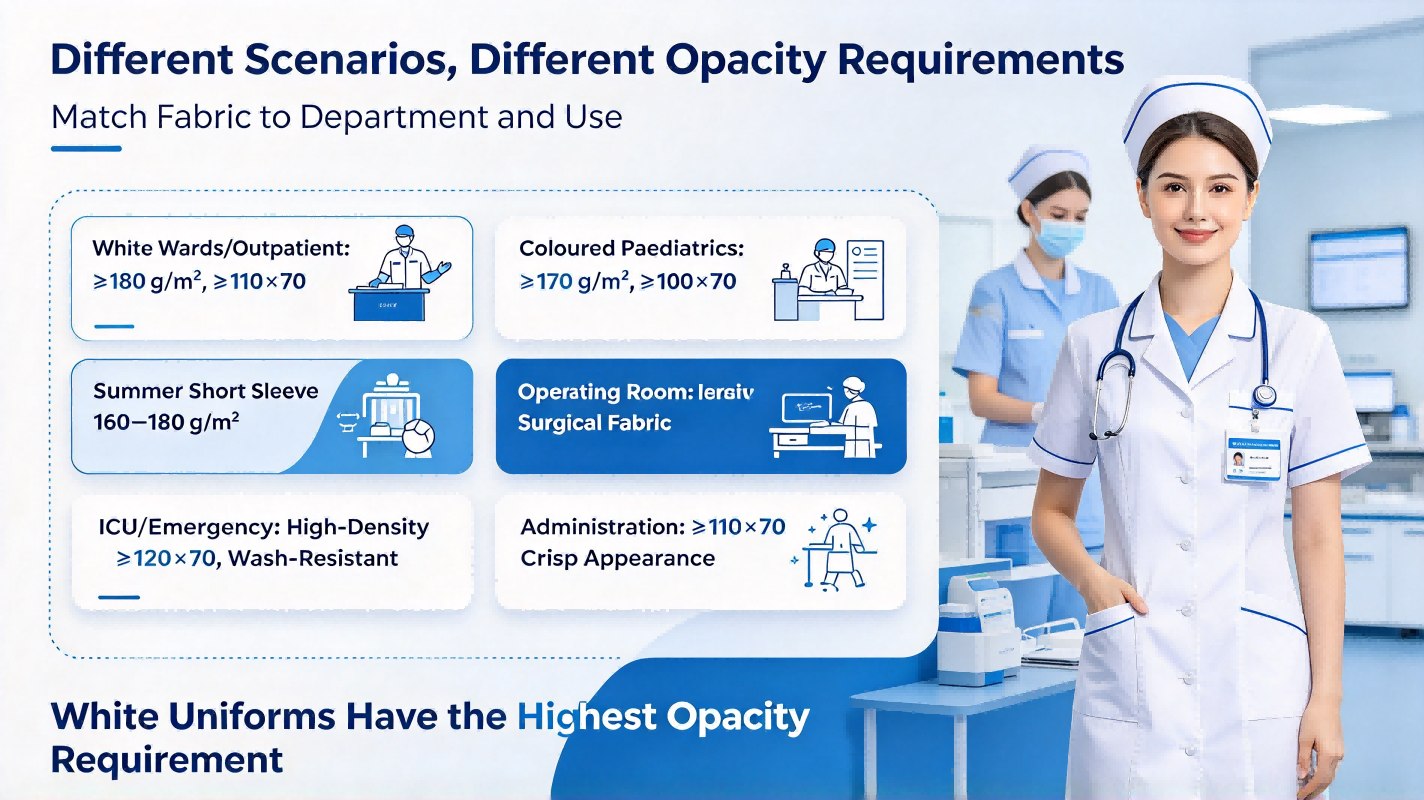
Not every nurse uniform needs to be "completely opaque." Different departments and wearing scenarios have different opacity requirements.
|
Scenario |
Opacity requirement |
Recommended configuration |
|
White nurse uniforms (wards, outpatient) |
High |
Weight ≥180 g/m², density ≥110×70, plain weave, opacity finishing |
|
Coloured nurse uniforms (paediatrics, obstetrics) |
Medium |
Weight ≥170 g/m², density ≥100×70, colour itself provides some coverage |
|
Summer short-sleeve nurse uniforms |
Medium-high |
Weight 160–180 g/m², density not below 110×70, white versions need opacity finishing |
|
Operating room scrubs |
High |
Special surgical gown fabric, high density, combined with fluid-repellent function |
|
ICU, emergency |
High |
Wash-resistant, opaque, quick-dry, density ≥120×70 |
|
Administration, health check centres |
Medium |
Crisp appearance priority, density ≥110×70 |
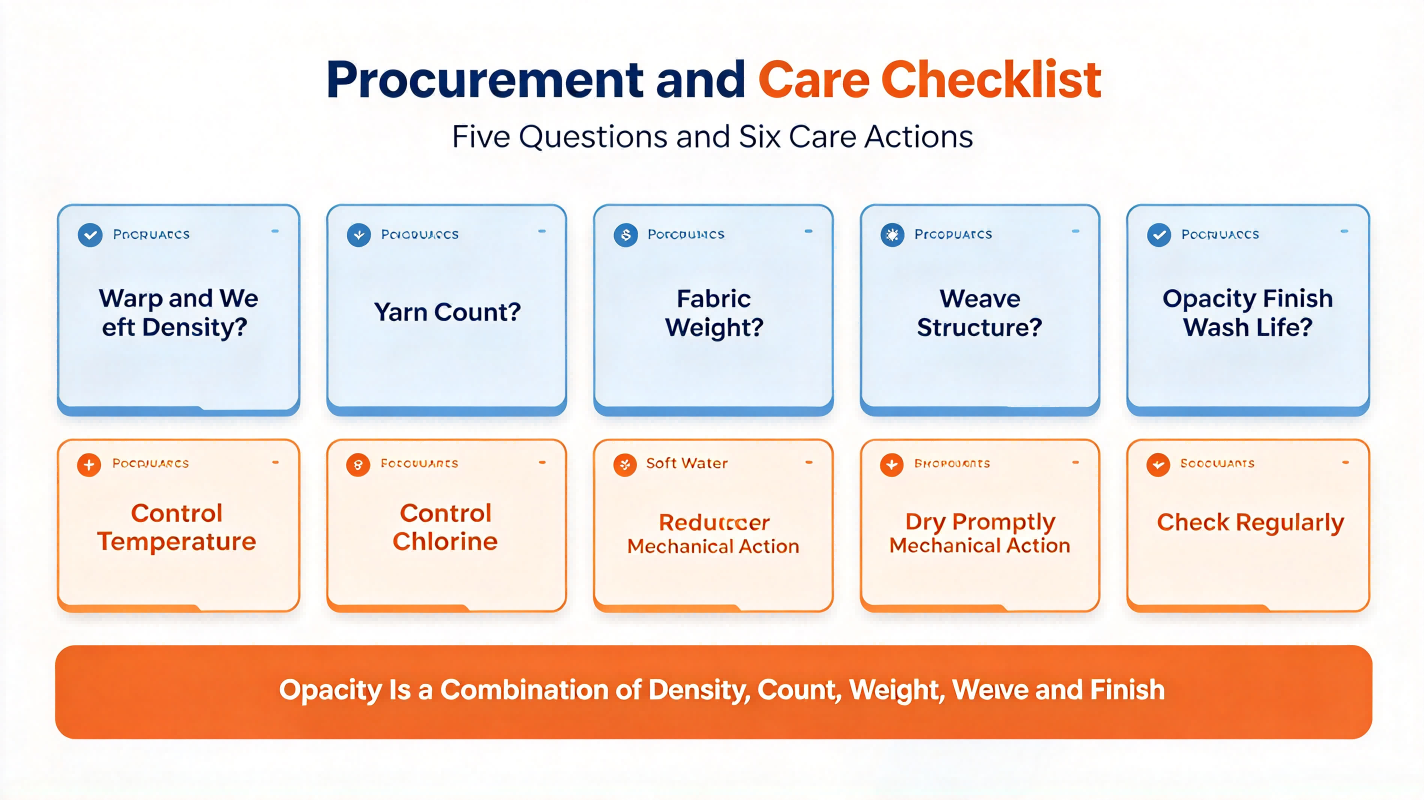
8. Five questions you must ask during procurement
First, what's the warp and weft density? Require specific numbers, such as 110×70 or 130×70. Don't accept vague phrases like "high density" or "dense."
Second, what's the yarn count? 32S or 40S? Combed or carded?
Third, what's the fabric weight? Require the g/m² value. White nurse uniforms should preferably be no less than 180 g/m².
Fourth, what's the weave structure? Woven plain weave, twill, or knitted? Plain weave is the most reliable for opacity.
Fifth, is there opacity finishing? Is it densifying, double-layer weave, or coating? How many washes will the opacity effect last?
9. How to prevent "getting more see-through with washing" during care?
Nurse uniforms becoming more see-through after repeated washing is mainly due to three reasons: fibre wear and thinning, larger gaps between yarns, and degradation of opacity finishing.
Washing and care recommendations:
First, control washing temperature. High temperatures accelerate fibre damage and fabric loosening. While meeting disinfection requirements, choose 70°C rather than 90°C where possible.
Second, control the amount of chlorine disinfectant. Chlorine disinfectant oxidises fibres, making the fabric thinner and more brittle. Control the dosage and rinse thoroughly.
Third, wash with soft water. Calcium and magnesium deposits in hard water make fabric stiff and also affect fibre structure. Soft water helps maintain fabric density.
Fourth, avoid strong mechanical action. Industrial washing machines have strong mechanical force. Don't wash for too long, and avoid excessive tumbling.
Fifth, dry promptly. Remove and hang to dry promptly after washing – don't leave uniforms piled in the machine.
Sixth, check regularly. If a white nurse uniform shows a noticeable increase in light transmission, the fabric has aged or the opacity finishing has degraded, and it's time to replace it.
10. A common misconception: "Thick means opaque"
Many buyers think the thicker the nurse uniform, the more opaque it is. That's not entirely true.
If thick fabric has low density and coarse yarn, even though the weight is high, the gaps between yarns are large, and it will still be see-through. Conversely, high-density fabric can have good opacity even if its weight isn't particularly high.
To judge opacity, look at five indicators – density, yarn count, weight, weave structure, and finishing – not just thickness.
A final honest word
Whether a nurse uniform is see-through isn't just a question of "thick or not." It's determined by density, yarn count, weight, weave structure, and opacity finishing together.
Density is the first threshold for opacity – 110×70 is the passing line for regular nurse uniforms, and 130×70 is more reliable.
Yarn count must be considered together with density – 32S + 110×70 is a balanced configuration; 40S + 130×70 is finer and more opaque.
Too light in weight definitely means see-through – white nurse uniforms should preferably be no less than 180 g/m².
Plain weave is the most opaque – give priority to woven plain weave for nurse uniforms.
Ask about wash resistance of opacity finishing – opacity finishing that fails after a few washes is as good as none.
During procurement, don't just ask "How much per piece?" Ask directly: "What's the warp and weft density? What's the yarn count? What's the weight? What's the weave structure? How many washes will the opacity finishing last?" – A supplier who can answer these five questions clearly is a supplier who truly understands nurse uniform fabric.
Nurse uniforms are professional equipment nurses wear every day. Whether they're see-through directly affects the wearer's comfort and professional image. Choose the right fabric, and nurses feel confident while the hospital has one less thing to worry about.