¿Qué estás buscando?



Introduction
For B2B buyers, anti-static workwear isn’t just about comfort—it’s about safety, compliance, and protecting multi-million-dollar equipment. Whether you’re equipping a semiconductor cleanroom or an oil refinery, understanding the difference between ESD and anti-static protection, and which certifications matter, is critical. This guide covers the key standards, performance parameters, and sourcing pitfalls—so you can order with confidence from a manufacturer like Golden Shield that meets both global and China-specific requirements.
1. ESD vs. Anti-Static: Two Different Goals
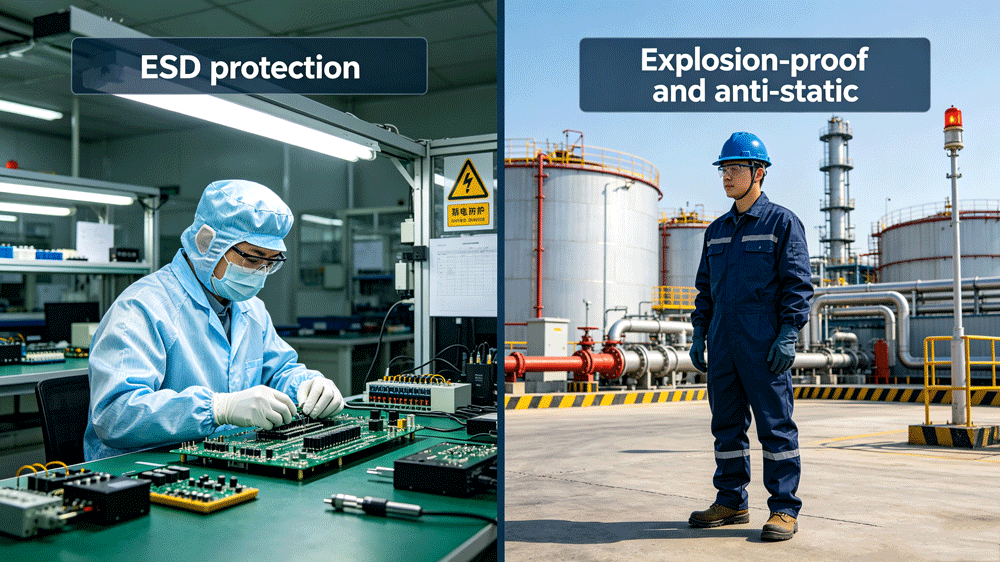
Static control falls into two distinct categories, and using the wrong one can be catastrophic.
ESD Control (Electronics Protection) – Designed to protect sensitive components from static discharge. Typical standards: IEC 61340-5-1, ANSI/ESD S20.20. Used in semiconductor, PCB assembly, and microelectronics industries.
Anti-Static / Explosion Prevention – Designed to prevent sparks in flammable atmospheres. Key standard: EN 1149-5, ATEX directive. Required in petrochemical, gas, paint spraying, and grain handling facilities.
2. Mandatory Certifications You Must Verify
Do not accept a supplier’s word alone. Always request third-party test reports from accredited labs (CMA/CNAS for China, or equivalent for international standards).
| Standard | Application | Application | |
| EN 1149-5 | EU explosive atmospheres | Surface resistivity ≤ 2.5×10⁹ Ω, charge decay test | |
| IEC 61340-5-1 | Global ESD control | Garment must be part of an EPA (Electrostatic Protected Area) | |
| ANSI/ESD S20.20 | North America ESD | Foundation for ESD control programs in electronics | |
| GB 12014-2009 | China mandatory | Defines A-level (explosive, 10⁵~10⁷Ω) and B-level (electronics, 10⁷~10¹¹Ω); charge density ≤7μC/m² |
Golden Shield provides full CMA/CNAS-accredited test reports for every batch, with data on surface resistance, charge density, and wash durability.
Performance Parameters That Matter
When comparing suppliers, focus on these measurable values:
Surface Resistance (Point-to-Point) – Must fall between 10⁵ and 10¹¹ Ω. A-level (high-risk) requires 10⁵~10⁷ Ω; B-level allows 10⁷~10¹¹ Ω. Too low can cause leakage; too high won’t dissipate static.
Charge Surface Density – ≤7μC/m² per GB 12014. High-end electronics often demand even lower (e.g., <0.6 μC).
Static Decay Time – Top-quality fabrics dissipate static in under 2 seconds, crucial for dynamic operations.
Wash Durability – Look for fabrics that maintain conductivity after 50–100 industrial washes. Avoid topical chemical coatings that wash out.
4. Fabric Construction: Permanent Performance vs. Coating
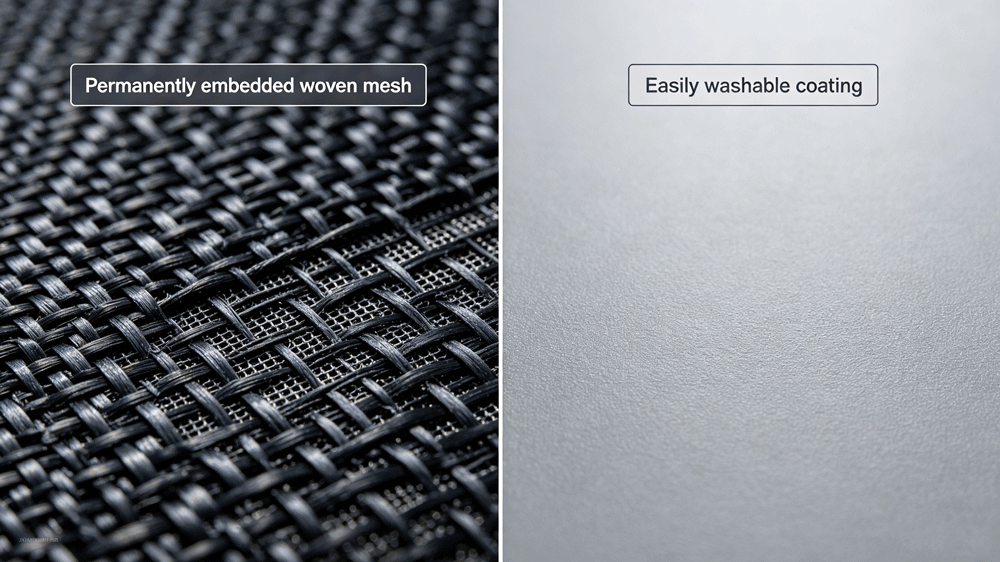
Anti-static properties must be built into the fabric structure, not just coated on.
Permanent Carbon Filament Weave – Conductive carbon fibers are woven into the base fabric (typically polyester/carbon blend) in a grid or stripe pattern. This provides lasting static dissipation.
Grid vs. Stripe – A grid pattern (both directions) offers multi-directional protection for cleanrooms and electronics. A stripe may suffice for general warehousing but is insufficient for high-risk ESD zones.
Avoid Topical Agents – Chemical anti-static finishes degrade after a few washes. Always verify that the conductive yarn is embedded, not just applied.
Golden Shield uses grid-weave carbon filament technology at 5mm spacing, ensuring permanent performance and compliance with the strictest cleanroom requirements.
B2B Procurement Checklist
Use this checklist to avoid substandard products:
Confirm standard applicability – EN 1149-5 for explosive areas, IEC/ANSI for electronics, GB 12014-2009 for China domestic/export.
Request third-party batch test reports – with CMA/CNAS stamp, less than 1 year old.
Check component continuity – zippers, buttons, thread, and cuffs must also be conductive or dissipative.
Verify wash test data – resistance should hold through at least 50 industrial washes.
Inspect garment construction – no broken conductive yarns, clean seams, correct labeling.
Remember the system – anti-static clothing works only with conductive footwear, wrist straps, and grounded flooring.
Golden Shield no es solo un proveedor, sino también un pilar confiable en su sistema de cadena de suministro. Ayudamos a los gerentes de compras a mejorar la resiliencia de la cadena de suministro y garantizar operaciones estables mediante la construcción de una cadena industrial sólida, procesos de gestión transparentes y modelos de cooperación colaborativos e innovadores.
Escudo Dorado-Su socio confiable de la cadena de suministro
WhatsApp:86 133 7788 3692
Correo electrónico:[email protected]